Master polyrhythms
from 3:2 to 16 against 16.
DrumShed's polyrhythm drill stacks two independent rhythms and lets you hear how they interlock. Start simple, build to complex. Internalize the relationship.
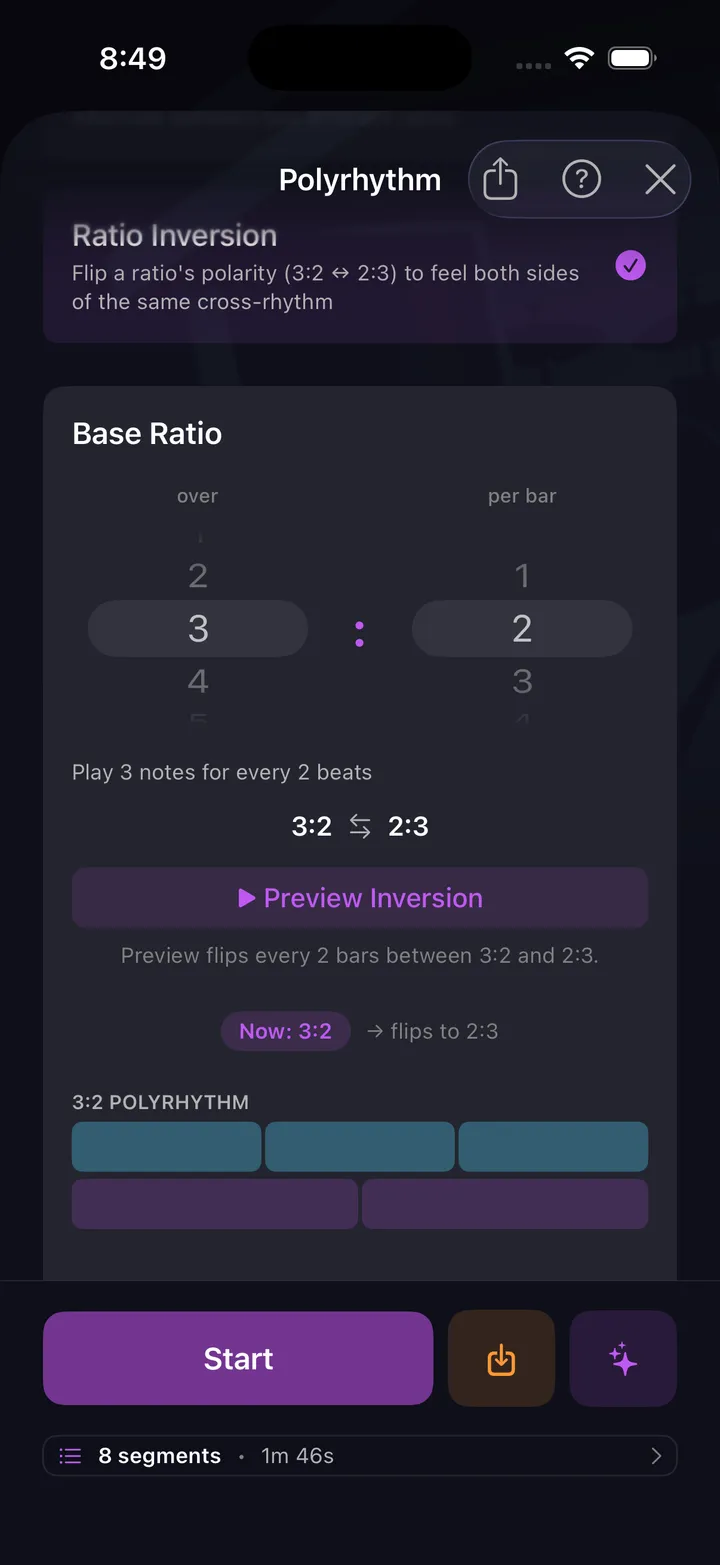
Two pulses, one body
A 3:2 falls apart the moment you try to count both hands. The drill plays each pulse on its own sound so your hands learn the spacing before your head catches up.
8 presets, plus the wheel
3:2, 4:3, 5:4, 5:3 and their inversions as presets — or dial in anything from 1–16 against 1–16 on the ratio wheel.
Two distinct voices
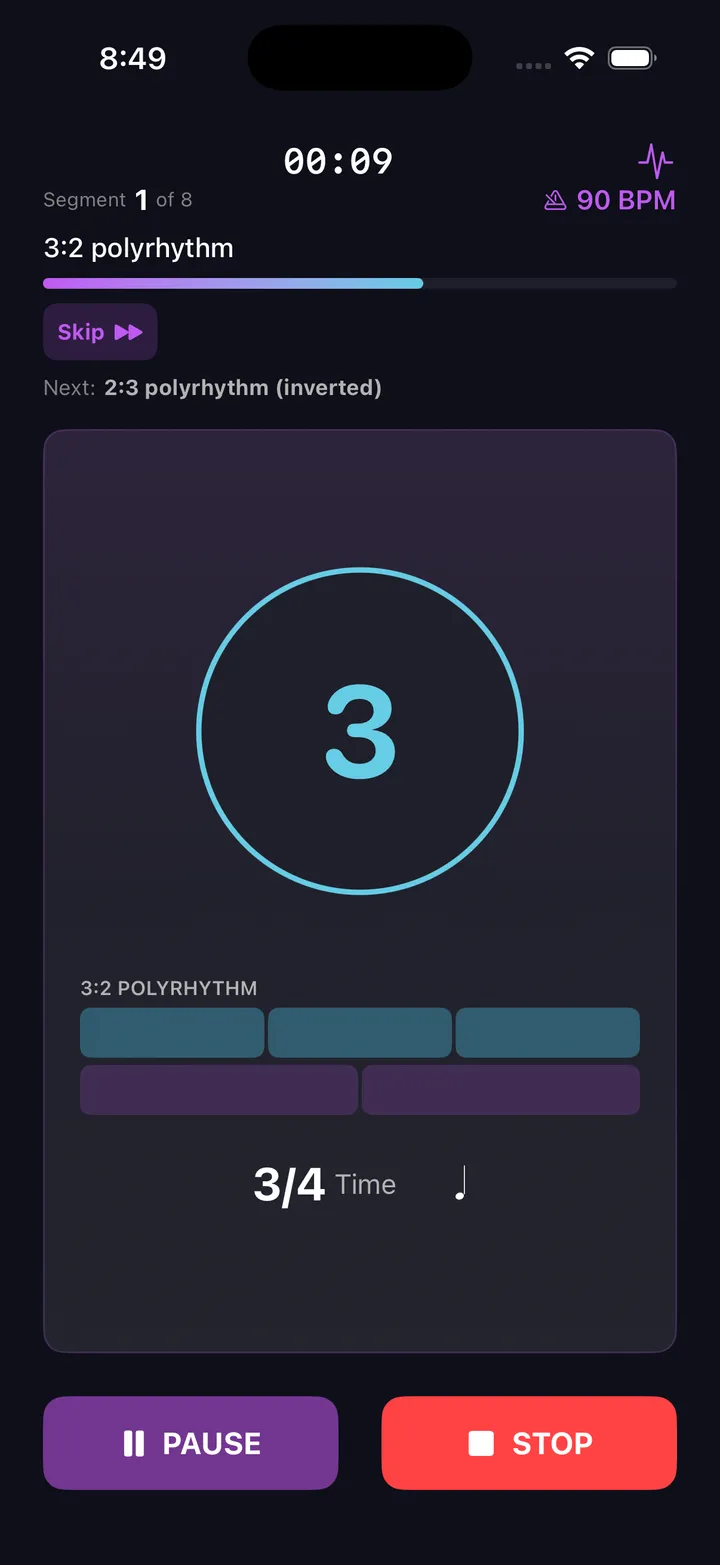
Each pulse gets its own click voice, so you always know which layer you're hearing — the base holds one sound, the poly answers with another.
Start slow
Begin at a tempo where you can hear every note of both rhythms. Speed up only when the relationship is locked in.
Hear it, then hold it
In/Out mode alternates base-only segments with the full stack. When the poly layer drops out, you keep it going in your head — that's the real test.
Visual pulse grid
Watch both cycles tick in a visual pulse grid and see exactly where they land together — and where they pull apart.
Practice history
Every polyrhythm session is logged — ratio, tempo, duration. Your history shows which ratios have gotten real reps.
Four practice modes
From first hearing a ratio to playing it without thinking.
In/Out mode
Loop a single ratio. Base pulse plays alone, then the poly layer enters. Stay here until you can feel it without thinking.
Progressive mode
Walk through ratios from simple to complex — 3:2 → 4:3 → 5:4. Build broad polyrhythmic fluency in one session.
Contrast mode
Alternate between two different ratios each cycle. Train your brain to switch polyrhythmic feels without losing tempo.
Inversion mode
Flip a single ratio every N bars — 3:2 then 2:3 then 3:2. Same notes, opposite feel. Drills the brain to hear either pulse as home.
Practice tips
Sing and play
Sing one rhythm while playing the other. Then swap. This builds the independence that makes polyrhythms feel natural.
Feet vs hands
Play the base pulse with feet and the poly with hands. Essential for real-world limb independence.
Learn in order
3:2 (Afro-Cuban), 4:3 (jazz), 5:4 (prog), 5:3 (advanced). Each builds on the last.
Slow it way down
If a ratio feels impossible, halve the tempo. The relationship becomes clearer when every note is audible.
Practice this in DrumShed
Free on the App Store & Google Play
“I can then break down more complicated patterns into simplified chunks and work my way up.”
★★★★★ · jtc180, App Store review
No floor. No ceiling.
Sketch a groove in seconds — or go places most apps can’t follow. You’ll never touch bottom.
7/8 · 11/8 · 13/4 · mixed subdivisions · swing & shuffle · ghost notes · pocket & feel · sticking
The Polyrhythm drill is free.
Not a trial, not a preview. The metronome underneath is complete — no limits, nothing held back — and this drill, along with all ten that aim it, ships in the free app, with hands-free sessions and your full drill history, stats and streaks. No ads, no card, not a timed trial. A subscription only comes in when you want to build your own beats and fills, publish them, or use the AI co-pilot.