Time signatures
explained for drummers.
What do the numbers mean? How do you count 7/8? What's the difference between 3/4 and 6/8? A practical guide for drummers who want to play beyond 4/4.
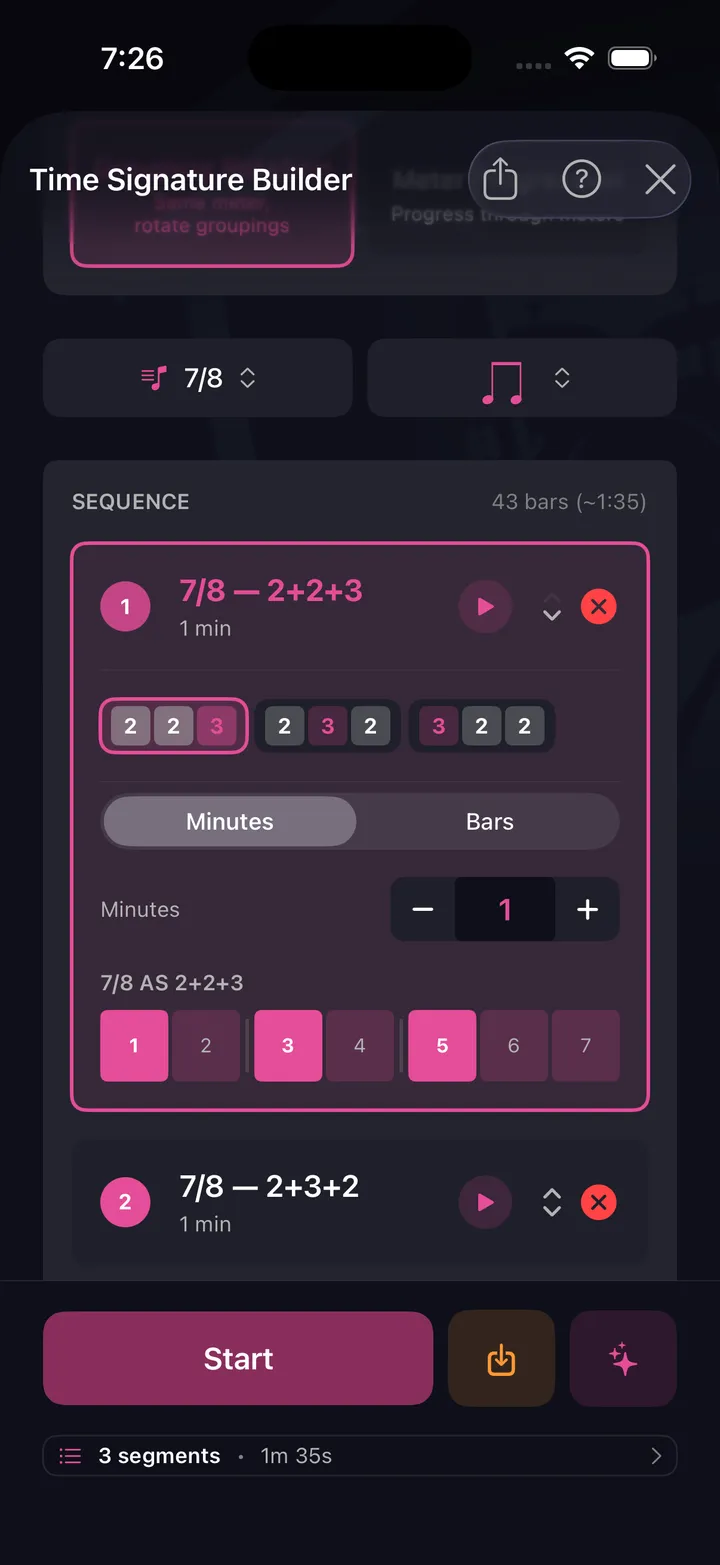
How to read a time signature
The top number tells you how many beats per bar. The bottom number tells you what note value gets one beat (4 = quarter note, 8 = eighth note).
So 4/4 means "4 quarter-note beats per bar." 7/8 means "7 eighth-note beats per bar." The magic is in how you group those beats.
4 quarter-note beats per bar. The most common time signature in rock, pop, hip-hop, funk, and most Western music. If you're playing popular music, you're probably in 4/4.
1 2 3 4Genres: Rock, Pop, Hip-Hop, Funk, Metal3 quarter-note beats per bar. The classic waltz feel — ONE two three, ONE two three. Also common in country, jazz ballads, and some folk music.
1 2 3Genres: Waltz, Country, Jazz Ballads6 eighth-note beats grouped as two sets of three. Feels like two big beats with a triplet subdivision. Common in blues, slow rock ballads, and African music.
1 2 3 4 5 6Genres: Blues, Ballads, African, Irish5 quarter-note beats per bar, often grouped 3+2 or 2+3. Think of "Take Five" by Dave Brubeck. Feels like 4/4 with an extra beat (or one missing).
1 2 3 4 5Genres: Jazz, Progressive Rock, Film Scores7 eighth-note beats per bar, commonly grouped 2+2+3, 3+2+2, or 2+3+2. Each grouping changes the feel entirely. Common in Balkan music and prog rock.
1 2 | 1 2 | 1 2 3Genres: Balkan, Progressive Rock, Math Rock12 eighth notes grouped as four sets of three. Feels like 4/4 with a triplet swing. The foundation of blues shuffle and gospel.
1 2 3 | 4 5 6 | 7 8 9 | 10 11 12Genres: Blues Shuffle, Gospel, Slow JazzLonger bars: 6/4 and 8/4
The six above are the common ones, but the top number can be anything. 6/4 is six quarter notes in a bar — count 1 2 3 4 5 6 with the weight on 1 and 4. It shows up in prog rock and in jazz tunes that feel like a stretched waltz.
8/4 is eight quarter notes in a bar. On paper it looks like two bars of 4/4, and you could write it that way — the reason to notate 8/4 instead is phrasing. If the riff, the fill, or the chord change resolves every eight beats rather than every four, one long bar tells the truth about where the music breathes. Gospel, prog, and a lot of instrumental hip-hop sit here.
Anything that isn't 4/4, 3/4, or 2/4 gets loosely called an odd meter — odd time. Strictly it means an odd-numbered top figure (5, 7, 9, 11), but drummers use it for any bar that doesn't divide neatly into four. In DrumShed you can dial any top number from 2 to 13 over a quarter or an eighth, so 6/4, 8/4, 9/8 and 11/8 are all just a spin of the wheel.
Is 4/6 a real time signature?
Almost never — if you've seen "4/6" it is nearly always 6/4 with the numbers the wrong way round. The bottom number names a note value, and note values double: 2 (half), 4 (quarter), 8 (eighth), 16 (sixteenth). There is no note worth "one sixth" of a whole note, so 6 can't sit on the bottom of an ordinary time signature. (Contemporary composers do occasionally write irrational meters like 4/6 on purpose, meaning four beats each a sixth of a whole note — but if you met it in a drum chart or a tab, read it as 6/4.)
So what's the difference between 3/4 and 6/8?
Both bars hold six eighth notes. The difference is how you group them. 3/4 groups them 3×2 — three beats, two eighths each: ONE-and TWO-and THREE-and. 6/8 groups them 2×3 — two big beats, three eighths each: ONE-two-three FOUR-five-six.
That's why 3/4 waltzes and 6/8 lilts. A waltz turns on three even steps; a 6/8 ballad rocks between two big pulses with a triplet roll inside each one. Same six notes — where you put the weight decides the feel. Play "My Favorite Things," then "House of the Rising Sun," and you'll never confuse them again.
Practice every meter on this page
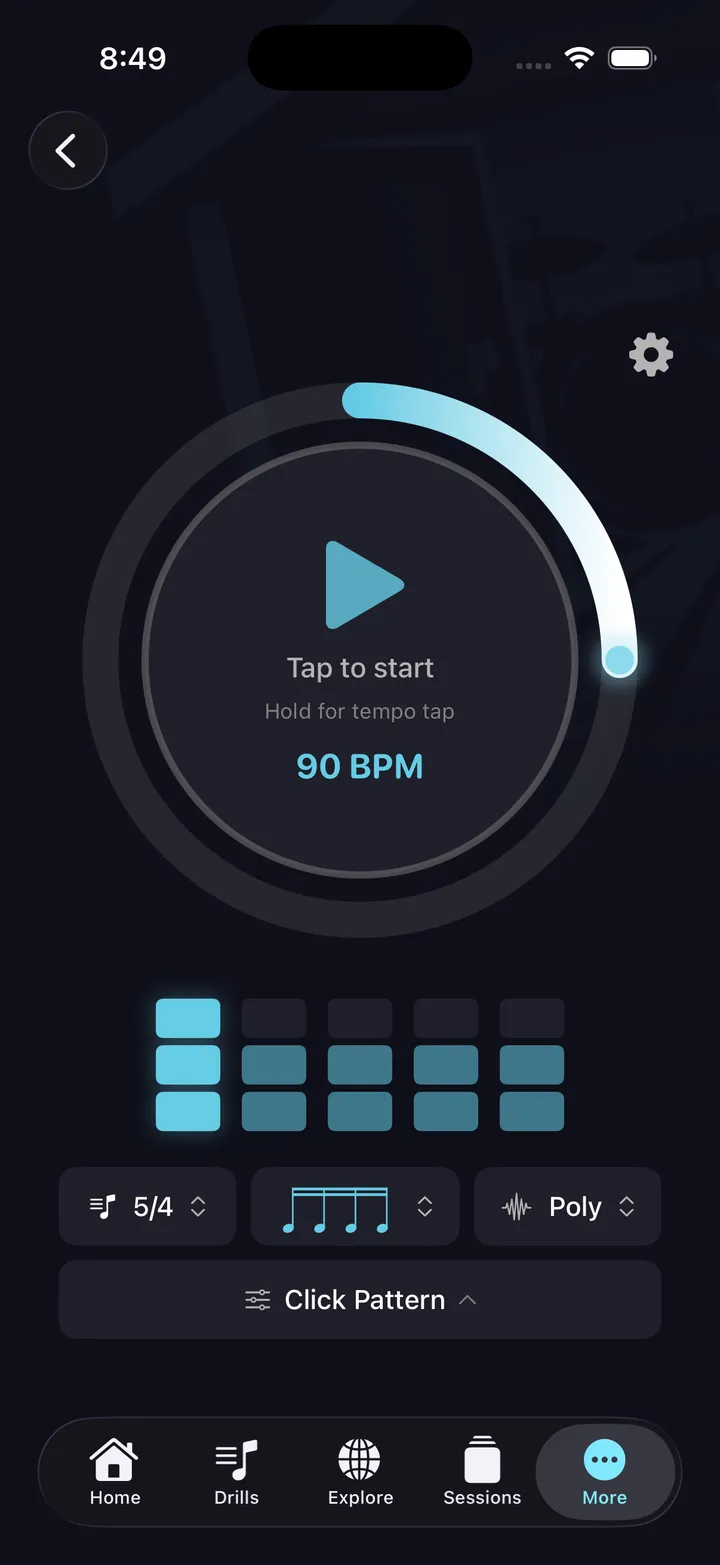
DrumShed's beat builder handles full grooves in any time signature from 2 to 13 over /4 or /8, with mixed subdivisions per beat. The Time Signature Builder drill adds custom 2s-and-3s groupings — 5/4, 7/8, 9/8, 11/8, up to 13/8. Building a groove? Toggle the count overlay to see 1 e & a — or 1 trip let for triplets — right above the notation.
Practice this in DrumShed
Free on the App Store & Google Play — the metronome is free forever, and all 10 drills are free
Every drummer needs
a home base.
Master every time signature.