Start slow. End fast.
Build speed without losing accuracy.
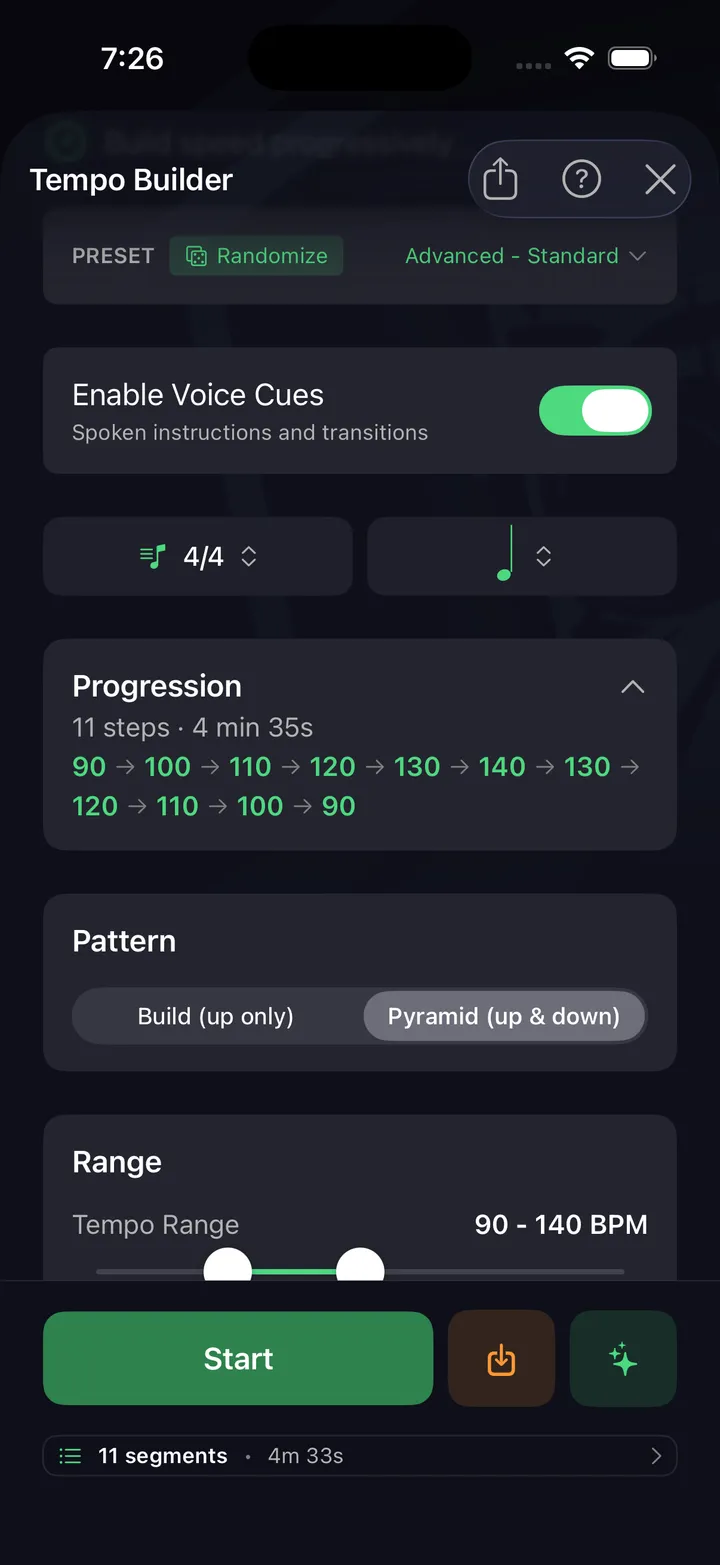
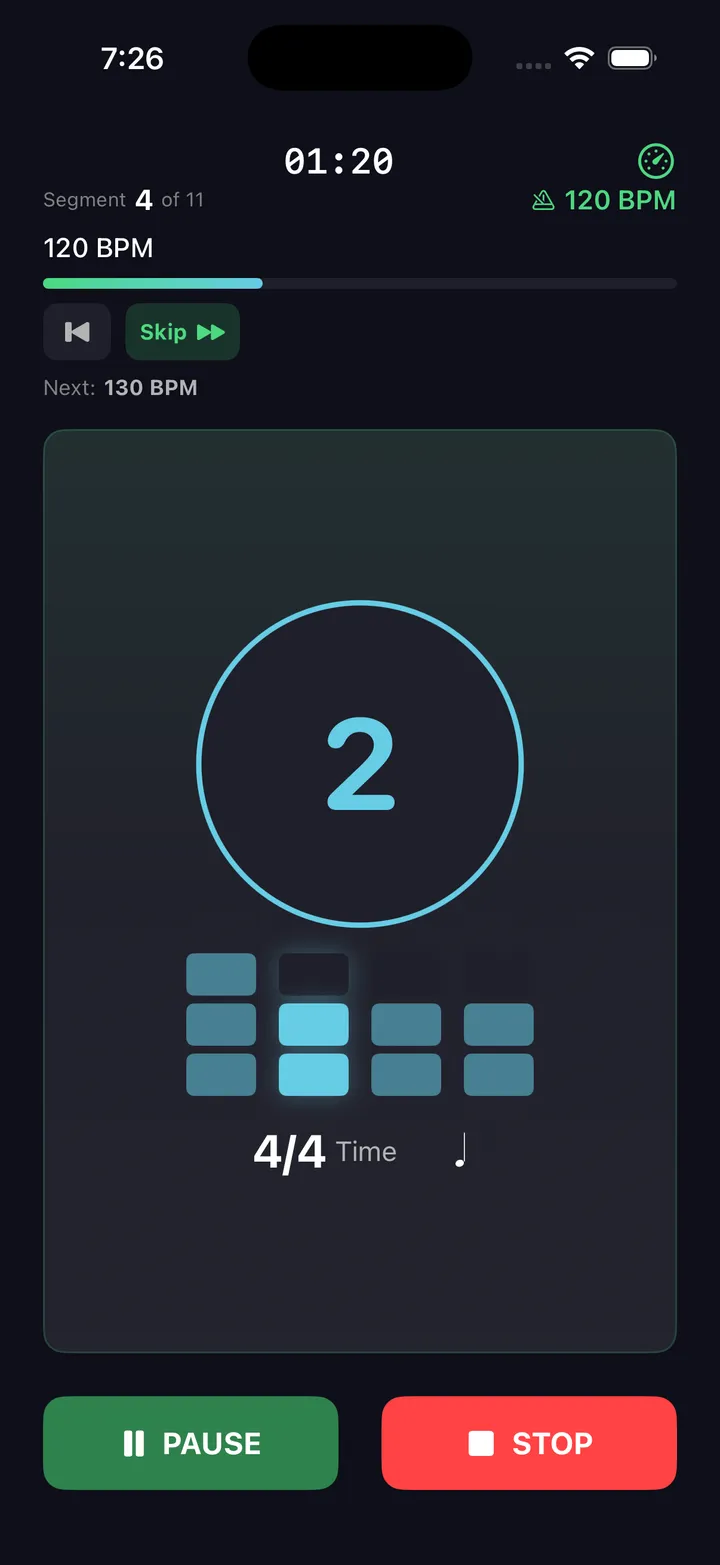
The Tempo Builder drill automatically ramps BPM, holding each tempo for a set stretch of time. Set your starting tempo, target tempo, and increment — it handles the rest.
Progressive tempo training
Auto ramp
Set start BPM, target BPM, and increment (1–20 BPM per step). The drill handles smooth transitions.
Time per step
20 to 60 seconds at each tempo before the next bump. More time = more consolidation at each speed.
Target tempo
Set a goal BPM for the session. The drill ramps up and stops when you get there.
Ramp down too
Build speed up, then ramp back down. Both directions train different aspects of control.
Practice history
Every run is logged — start, target, increment, duration. Scroll back a month and watch the target tempos climb.
Stack in sessions
Combine tempo building with other drills. Warm up slow, build speed, then practice at target tempo.
The same ramp works on your own material: tap Learn This on a beat or fill you've built and it climbs day by day on a practice path.
Two progression patterns
Build pattern
Ramps tempo up in steps from start to end — then stops. Best for pushing your max tempo. Set the end 5-10 BPM above your current ceiling.
Pyramid pattern
Ramps up to peak, then steps back down. The cooldown reinforces control at tempos you just struggled with. Playing clean after pushing your max is the real skill.
Practice tips
Note your ceiling
If you lose control at a step, that's your current limit. Note the BPM and target it next session.
Pyramid for endurance
The descent phase after pushing your max reinforces control. Use pyramid for longer sessions that build up and cool down.
Small increments
5 BPM per step gives fine control. 10 is standard. 20 is aggressive. Match the increment to your goal.
Settle in at each step
30 seconds minimum at each tempo to settle in. 60 seconds for deep practice. Rushing through steps defeats the purpose.
Practice this in DrumShed
Free on the App Store & Google Play
“this app is like having a personal drum coach in my pocket”
★★★★★ · jtc180, App Store review
The Tempo Builder drill is free.
Not a trial, not a preview. The metronome underneath is complete — no limits, nothing held back — and this drill, along with all ten that aim it, ships in the free app, with hands-free sessions and your full drill history, stats and streaks. No ads, no card, not a timed trial. A subscription only comes in when you want to build your own beats and fills, publish them, or use the AI co-pilot.
Every drummer needs
a home base.
Speed follows accuracy. Build both.