Drum exercise generator
— built from the mechanism up.
Most generators hand you a random pattern. This one asks what you're trying to train, then builds a multi-bar exercise where the thing you're working on visibly moves — and derives the bar count so the plan actually resolves.
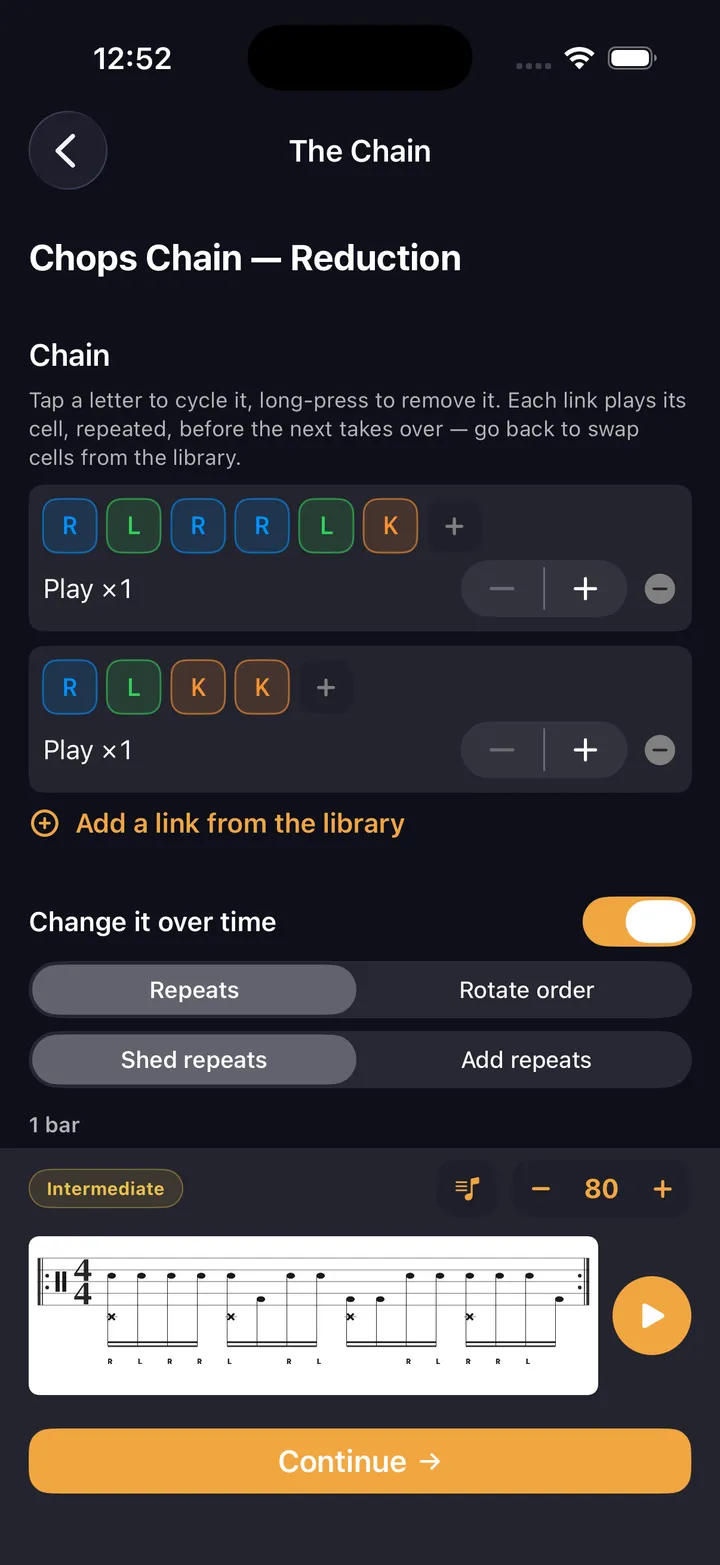
Five steps, and two of them are optional
And you never start from a blank page twice: a saved exercise keeps its whole recipe, so it reopens in the wizard with every parameter still set — ready to permute rather than rebuild.
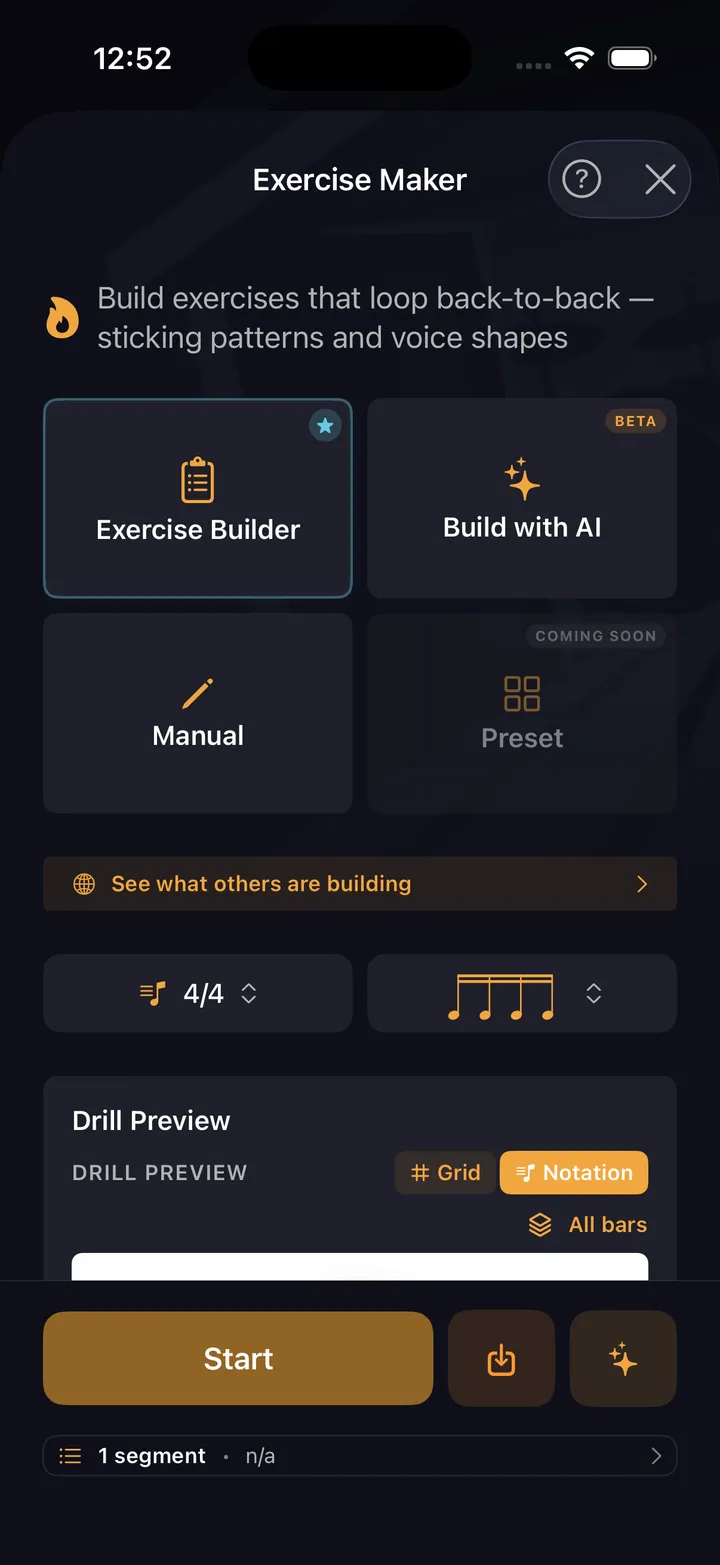
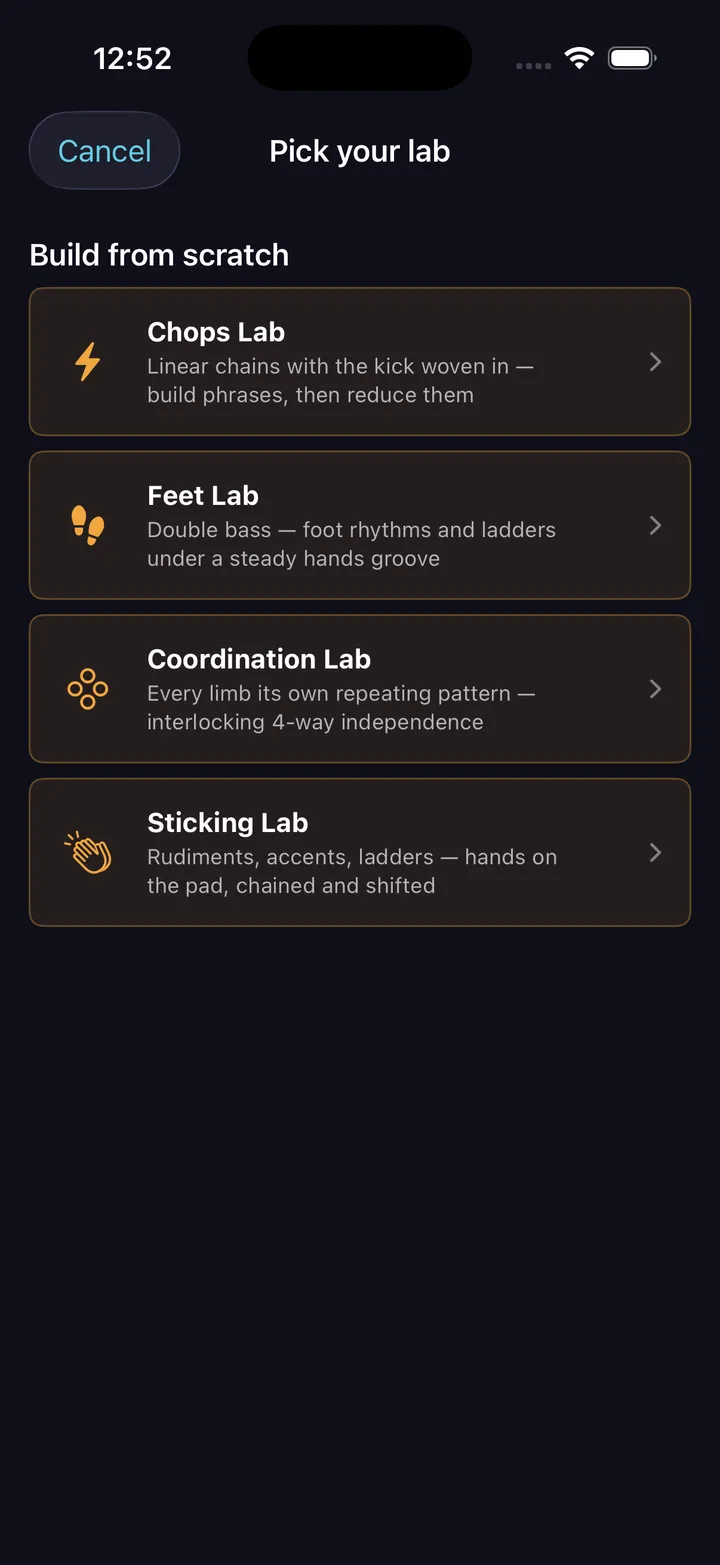
Pick a lab
Sticking, Rudiments, Chops, Feet, or Coordination. The door sets the sticking pool and the defaults — Sticking Lab hides kick cells, Rudiments Lab picks from the PAS 40, Chops Lab opens straight into a multi-segment chain on sextuplets, Feet Lab routes the generated rhythm to the kick.
Build the stream
A sticking cell, or a chain of them with per-segment repeat counts. Pick your base grid and time signature here too. Single-cell users never see the chain UI — it looks like a plain sticking picker until you add a link.
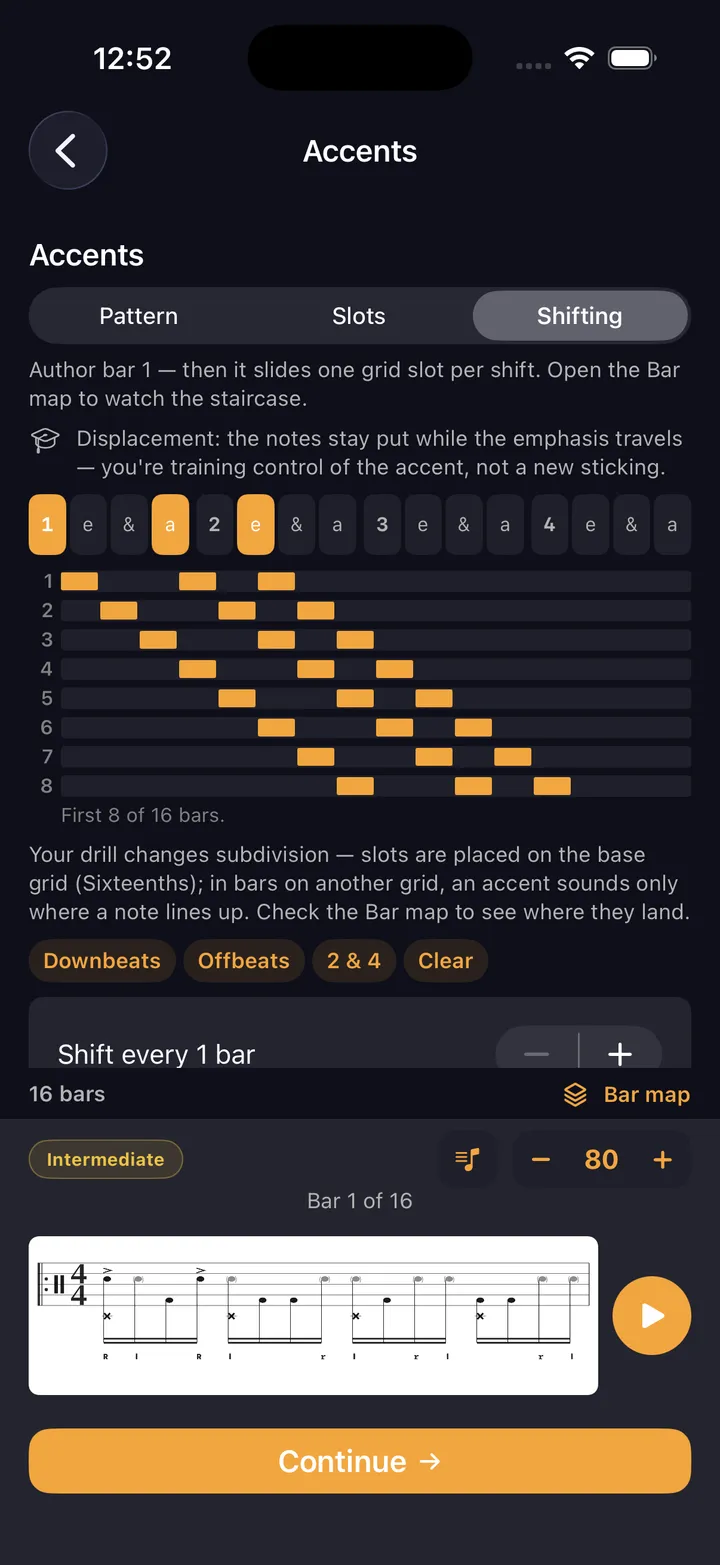
Choose what moves
The dimension that varies over time: the subdivision ladder, the accent position, or the chain itself. Direction is up, down, or pyramid, and the interval can ramp — shift every four bars, then every two, then every one.
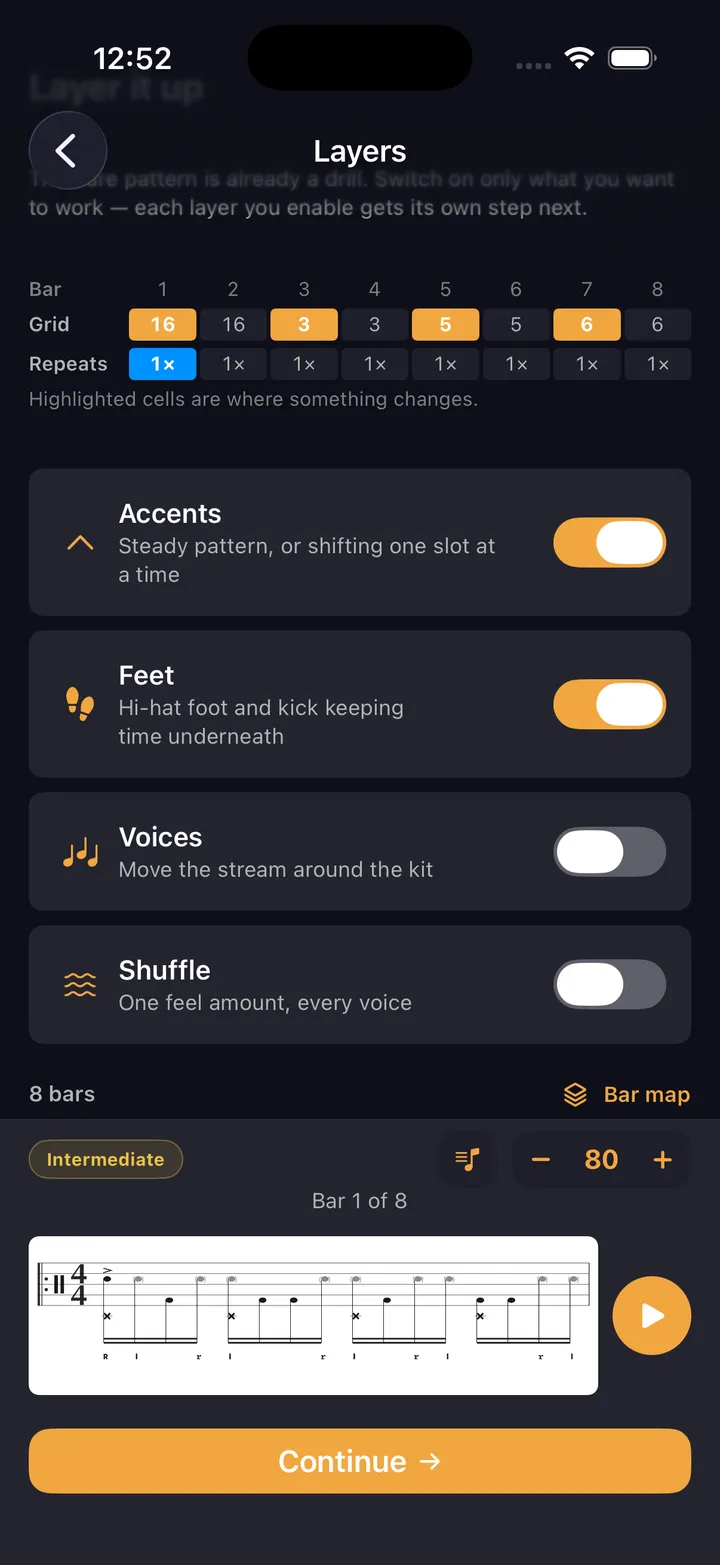
Check the layers you want
One screen of toggles: accents and flams, hi-hat foot, kick time, a uniform shuffle percentage, and kit voicing. The wizard only walks the ones you check, so a plain rudiment drill stays three steps long.
Set the tempo ladder
Start, target, step. Then it hands off to the standard config screen, where you start it, save it, publish it, or open the whole thing in the pattern editor and move individual hits.
Generated, not randomized
The same parameters produce the same exercise, every time. “Make it harder” is a parameter change, not a re-roll — which is what lets a family of drills share a stem and sit next to each other in your library.
Rules it won't break
A rudiment stays on the snare. A hand-foot exercise has to contain a kick. When both hands are on a continuous stream the hi-hat moves to the foot, because one hand can't be in two places. These are refusals in the builder, not advice in a tooltip.
Permutation is the point
From any exercise: change the sticking, move the accent to the kick, make it a flam, re-grid to triplets. Each one is a new drill in the same family — which is how one idea becomes eight.
Any meter, any grid
2 through 13 over 4 or 8, mixed subdivisions inside a single beat, and quintuplets and sextuplets alongside the usual ones. In x/8 the beat is an eighth, and the grid arithmetic knows it.
Or place every hit yourself
The generated exercise opens in the full pattern editor. Move hits, add flams, mute a voice, swing one limb, drag the pocket off the grid — the generator gives you a starting point, not a cage.
Left-handed all the way through
Set your stance once and stickings mirror for you, in the builder and on the stand. Patterns are stored right-hand-lead underneath, so what you publish still reads correctly for everyone else.
It names itself, plainly
An exercise gets a literal name — Single Paradiddle, Hand-Foot Singles — not an evocative one. A library where the paradiddle drills are called 'Coiled Stagger' is unusable even when every pattern in it is right.
Or just describe the problem
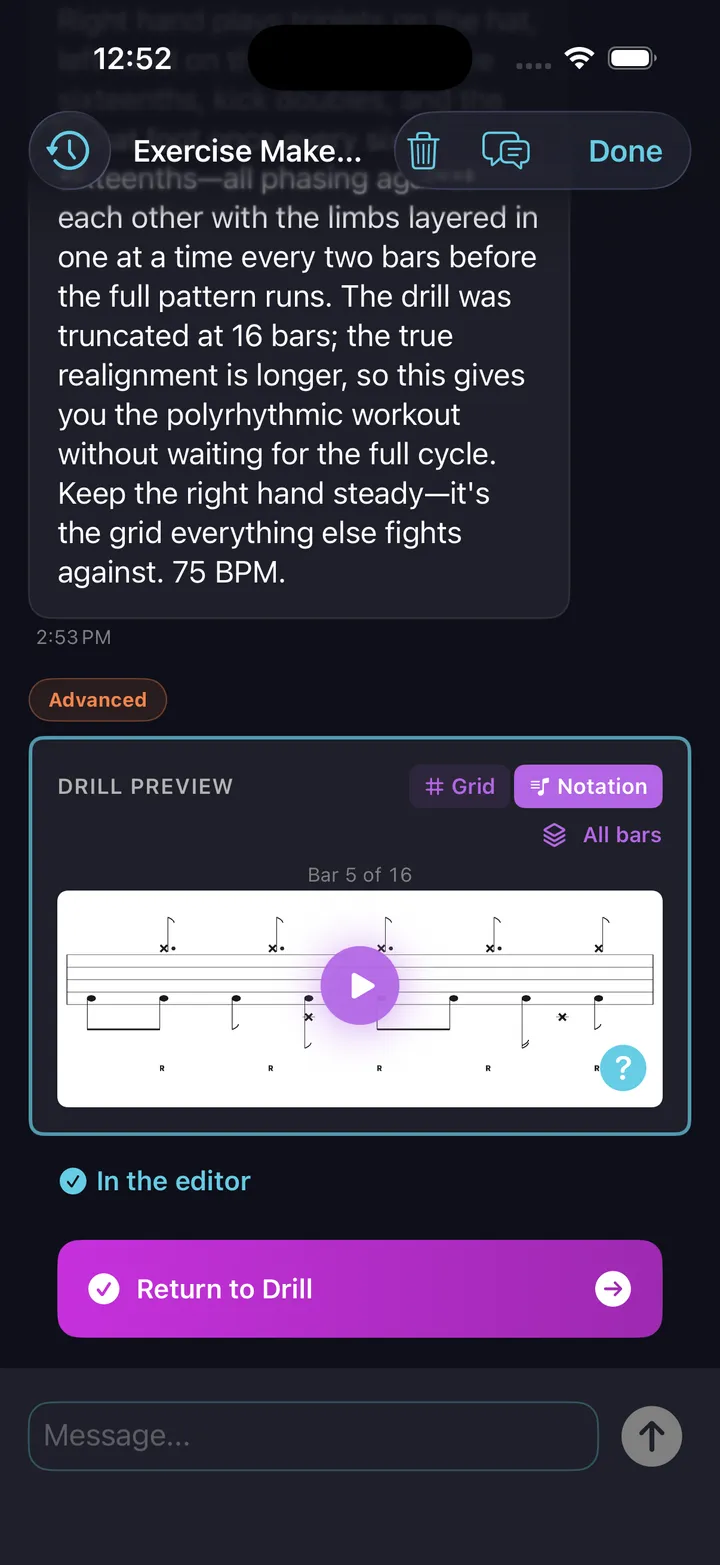
The builder assumes you know what you want to build. Often you don’t — you know what isn’t working. The AI exercise coach takes the complaint instead of the spec: “my doubles are uneven,” “my left foot is useless,” “I can’t play anything in 7.”
It names the mechanism behind the complaint, offers a progression rather than a single drill, tells you what to listen for at each step, and reaches for an exercise already in the library before generating a new one. Ask it to make something harder and it permutes — a different sticking, the accent on the kick, a re-grid — instead of just piling on notes.
The AI co-pilot is in beta. It drafts; you play it and decide whether it’s any good.
Every drummer needs
a home base.
Describe it. Build it. Climb it.