The single stroke roll
— rudiment #1.
Alternating strokes, R-L-R-L: the rudiment everything else is built on. Hear it, watch the sticking, and take it from slow eighths to a working roll around the kit.
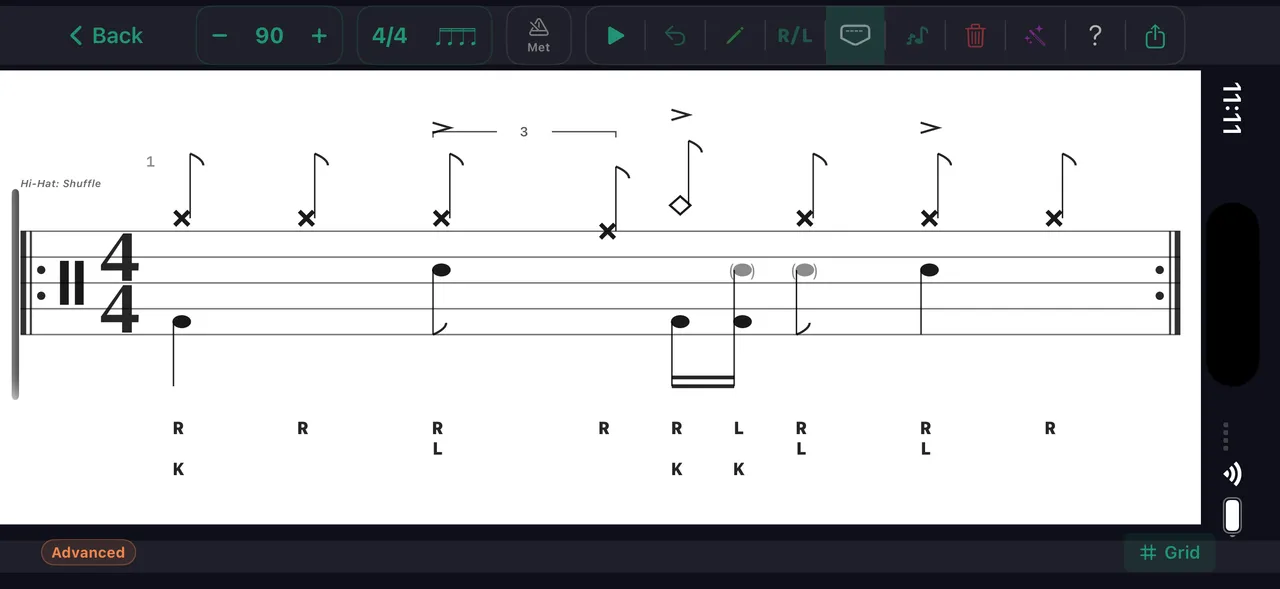
The single stroke roll is the first of the standard drum rudiments and the one you'll play most for the rest of your life. The rule is simple — hands strictly alternate, every note even — and the craft is a lifetime of making "even" true at every tempo and volume. The R and L letters under each staff show the sticking (new to the staff? read the drum notation guide first).
Step 1: eighth notes, painfully even
Start at 60–70 BPM playing eighth notes. Two things matter: identical stick height for both hands, and notes that land exactly with the click. Boring is the goal — if it's exciting, you're going too fast.
Step 2: sixteenth notes — the working roll
Double the density: four notes per beat, counted "1 e & a". This is the version you'll actually use in fills and solos. Keep the same relaxed motion from step 1 — the tempo knob moves, the technique doesn't.
Step 3: add accents
Accent the first note of every beat and drop everything else to a tap. The accents outline the pulse while the taps keep the motor running — this is where the roll starts to sound musical instead of mechanical, and it's a workout for dynamic control.
Step 4: take it around the kit
The same R-L-R-L walked from snare to high tom to mid tom to floor tom, with the kick marking each beat underneath. This is the classic beginner fill — and proof that a "basic" rudiment is really a fill generator in disguise.
Single stroke roll FAQ
What is a single stroke roll?
The first drum rudiment: strictly alternating strokes, R-L-R-L, at an even rhythm and volume. Every fill you've ever air-drummed, most fast solos, and half the warm-up routines in the world are single strokes — it is the alphabet the rest of drumming is spelled with.
How fast should my single stroke roll be?
Even beats fast. Judge the roll by whether the right and left hands are indistinguishable in volume and spacing, not by BPM. Speed arrives as a side effect of thousands of relaxed, even repetitions at tempos where you stay loose — and disappears the moment you tense up chasing it.
Should I play singles from the wrist or the fingers?
At slow and medium tempos, mostly wrist with a relaxed grip. As tempo climbs, the fingers gradually take over the rebound. Don't force the transition — practice slow enough that the stick rebounds on its own and let your hands find the split.
Why do my single strokes sound uneven?
Almost always the non-dominant hand: it strikes from a lower height, producing a quieter note. Practice leading with your weak hand, watch stick heights in a mirror, and slow down until every stroke starts from the same height. Even heights produce even sound.
Drill it in DrumShed
Loop these steps at any tempo with a spoken count-in — the builder's exercise mode runs a sticking back-to-back with no beat bars — nudge the BPM up session by session, and watch your practice history stack up. Then make it yours: send the accented hand to a tom in the pattern editor, save the variation, and tap Learn This to ramp it day by day. When singles feel automatic, the double stroke roll is next.