How to read drum tabs
— and what they can't tell you.
Drum tab explained row by row, with every example shown twice: the tab, then the same bar as real notation you can play and hear.
Drum tab is a plain-text shorthand invented for forums and email: one row per drum, one character per slice of time. It's quick to read and quick to write, which is why so much online drum content uses it. It's also imprecise — so on this page every tab is paired with the same bar in standard notation you can press play on and hear.
The anatomy of a drum tab
Here's the most-played beat in popular music written as tab. Three rows: hi-hat, snare, bass drum. Sixteen character positions per bar means each position is a sixteenth note, so the hi-hat's every-other-position "x" works out to eighth notes. The snare lands on positions 5 and 13 — beats 2 and 4 — and the kick on 1 and 9, which are beats 1 and 3.
HH|x-x-x-x-x-x-x-x-|
SD|----o-------o---|
BD|o-------o-------|
And the same bar as notation — press play and the two representations lock together in your head:
Row abbreviations and symbols
These are the common conventions. "Common" is doing real work in that sentence — tab has no governing standard, so expect variation between sources.
Where tab runs out: the open hi-hat
A capital X on the hi-hat row means "open it here" — that's the whole vocabulary tab has for hi-hat articulation:
HH|x-x-X-x-x-x-x-x-|
SD|----o-------o---|
BD|o-------o-------|
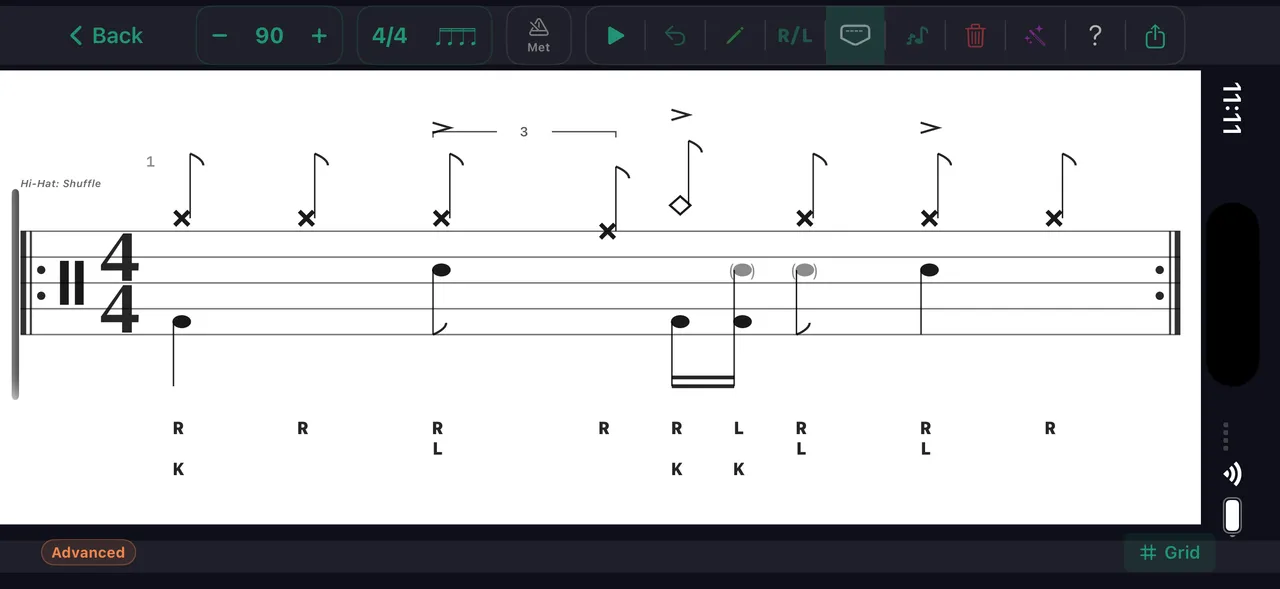
Notation says more. Below, the open hat carries a circle (○) above it, and the very next hi-hat note carries a + — telling you exactly where to close the hats again so the wash stops. The tab above leaves you guessing; the notation tells you when the sound ends.
Reading a fill in tab
Four sixteenths each on snare, high tom, mid tom, floor tom — the classic around-the-kit fill. In tab it's four tidy blocks of "o":
SD|oooo------------|
T1|----oooo--------|
T2|--------oooo----|
FT|------------oooo|
Same fill, engraved
What the tab doesn't say: which hand plays what. The notation below adds sticking letters (R-L alternating the whole way), which is the difference between a fill you can play at speed and one that trips over itself.
Tab vs. notation, honestly
Use tab for what it's good at — passing a groove to a friend in a text message. When the rhythm gets detailed, read notation. Our guide to reading drum notation takes you through the staff from scratch, and every pattern in DrumShed renders as notation you can slow down and loop.
Drum tab FAQ
How do you read drum tabs?
Each row is one drum or cymbal, labelled with an abbreviation on the left (HH = hi-hat, SD = snare, BD = bass drum). You read left to right; every character position is one slice of time, usually a sixteenth note. An "x" or "o" means hit that drum on that beat, and a dash means don't play it.
What does x mean in drum tabs?
A lowercase "x" is a hit on a cymbal or closed hi-hat, and "o" is a hit on a drum. A capital "X" on a hi-hat row usually means an open hi-hat, and "g" or a letter in parentheses on a snare row usually means a ghost note — but these conventions vary between transcribers, which is one of the weaknesses of tab.
Are drum tabs better than sheet music?
Tabs are easier to type and quicker to skim, so they're everywhere online. Standard notation is more precise: it shows exact note durations, triplets and other odd groupings, dynamics, and sticking, and every teacher and method book uses it. Most drummers start with tabs and graduate to notation once patterns get rhythmically complex.
What are the limits of drum tab?
Tab has no reliable way to show note length, triplets and quintuplets, dynamics beyond a rough loud/soft, sticking, or rolls — and there's no single agreed standard, so two transcribers may use different letters for the same sound. Anything rhythmically detailed is clearer in notation.
How do I convert drum tab to sheet music?
Count the columns per beat (usually four for a sixteenth-note grid), then place each row's hits at the matching position on the staff: kick in the bottom space, snare in the third space, hi-hat and cymbals above the top line with × noteheads. Playing the pattern back while watching the notation — as the examples on this page do — is the fastest way to make the mapping stick.
See any pattern both ways in DrumShed
The app's grid view is the honest version of what tab was reaching for — one row per voice, one column per subdivision — and one tap flips it to full notation with a moving playhead. Same pattern, both languages.