Stick control exercises
that permute themselves.
The Sticking Lab builds hands-only technique drills from cells you chain together — singles, doubles, paradiddles, or your own R/L string. Then it varies them: rotate the order, count the repeats down, climb the subdivisions, or walk an accent through the bar.
A page of permutations, without the page
Stick control books are lists of cells and an instruction to repeat each one twenty times. The value was never the cells — it was the systematic permutation. That part automates cleanly.
Chain any cells
Link cells with per-segment repeat counts. RLRR four times, then RLLR twice, then RRLR once — as one continuous exercise rather than four things you remember to do in order.
Rotate the order
Let the chain rotate its segments each cycle so no cell always lands on beat one. The permutation you keep skipping is the one you need.
Count the repeats down
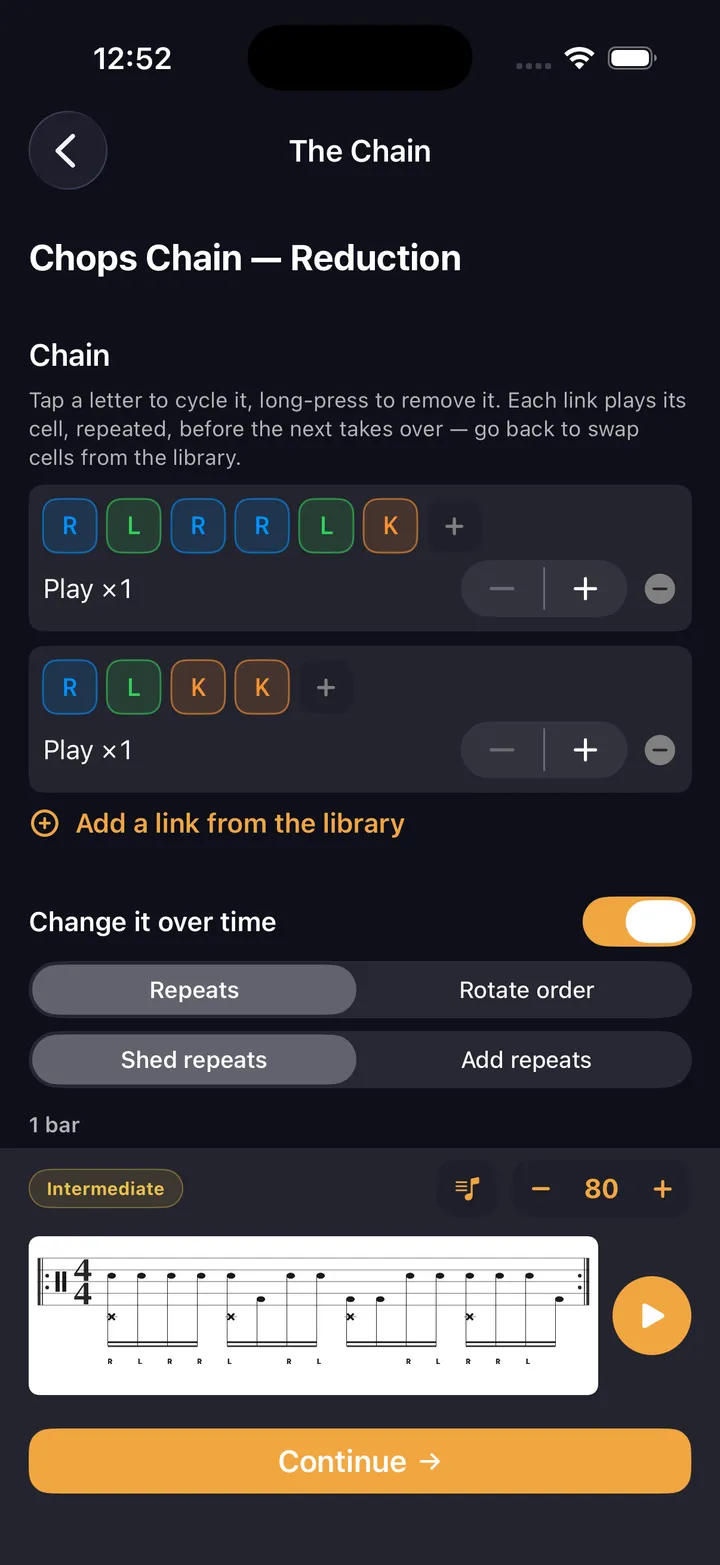
The reduction drill as a setting: four repeats, then three, then two, then one. The transitions are the work, and this puts you through all of them without bookkeeping.
Climb the subdivisions
Play the same sticking as eighths, then triplets, then sixteenths, then quintuplets — up, down, or as a pyramid. The sticking stays; the grid underneath moves.
Real ghost notes
Unaccented strokes sit far below the accents, not slightly under them. Evenness drills carry no accents at all, on purpose — that is a rule the builder enforces rather than suggests.
It stays on the snare
A rudiment practiced across three toms is a tom fill wearing a rudiment's name. The Sticking Lab keeps it on one surface unless you explicitly ask for orchestration.
Four stick control drills to build
Each of these is a few taps in the Sticking Lab — and each is a family, not a drill.
Single-beat combinations, permuted
RLRL · RLRR · RLLR · RRLRThe Stick Control idea in one drill: chain four cells, one per bar, and loop the whole thing. Uniform velocity, no accents — an accent gives the weak hand something to hide behind, which is exactly what you are trying to expose. Start at 60 and hold there until the four bars sound like one bar.
Reduction: four, three, two, one
RLRR ×4 → ×3 → ×2 → ×1Set one cell and let the chain count its own repeats down as the exercise runs. The hard part is never the sticking, it is the transition — the bar where the count changes is where the tempo wobbles. Ten bars long, and the builder works that length out for you.
Accent-tap control
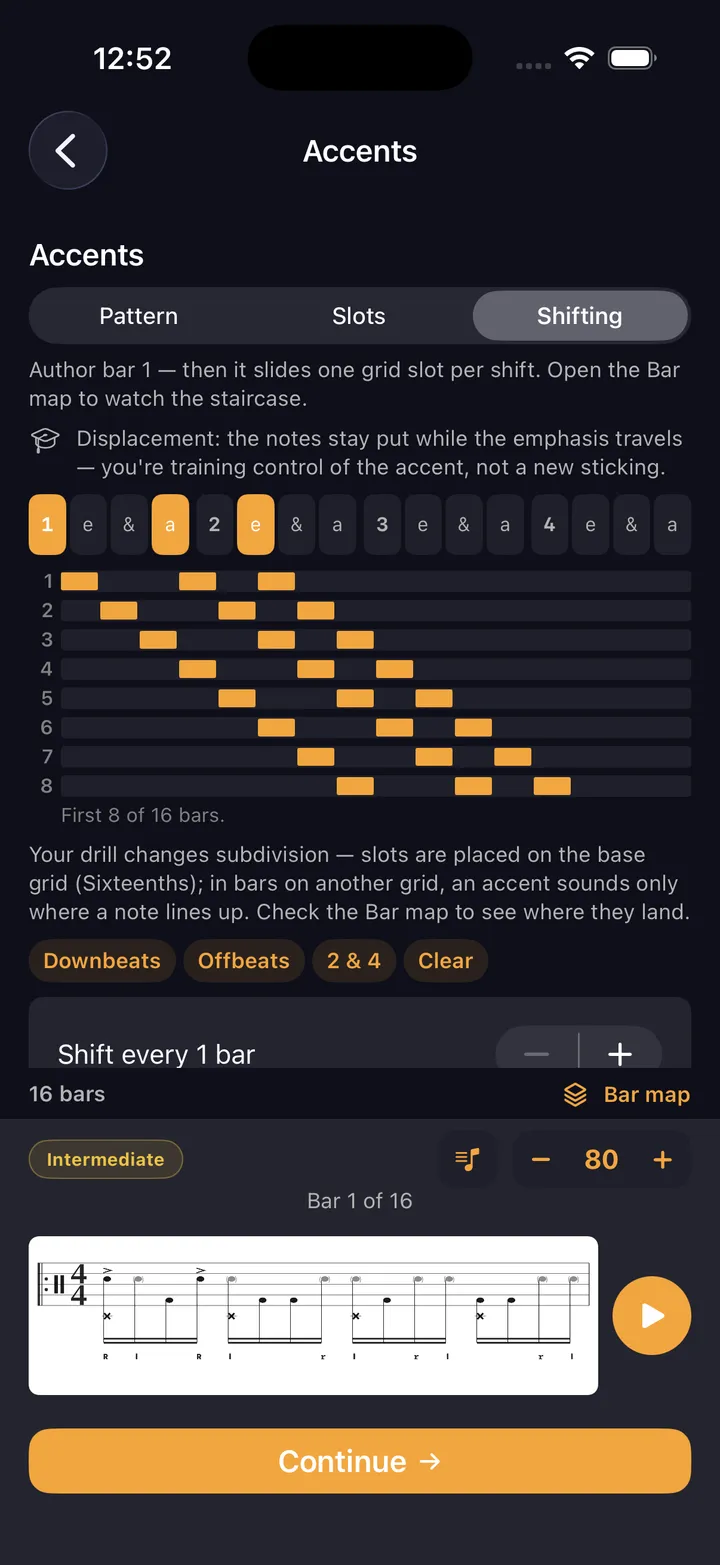
RLRLRLRL, accent movesAlternating singles at a steady stream, one accent, and the accent moves one slot per cycle. Everything unaccented sits down at ghost level — genuinely quiet, not "a bit softer". Sixteen bars gets the accent through every position; the bar map draws it as a staircase before you play a note.
Singles to diddles
RLRL → RRLLTwo cells, alternating, uniform velocity throughout. The doubles must sound exactly as even as the singles at the same tempo, and they will not — that gap is the drill. Climb it on a tempo ladder in 5 BPM steps rather than jumping to where you want to be.
On the pad or on the kit
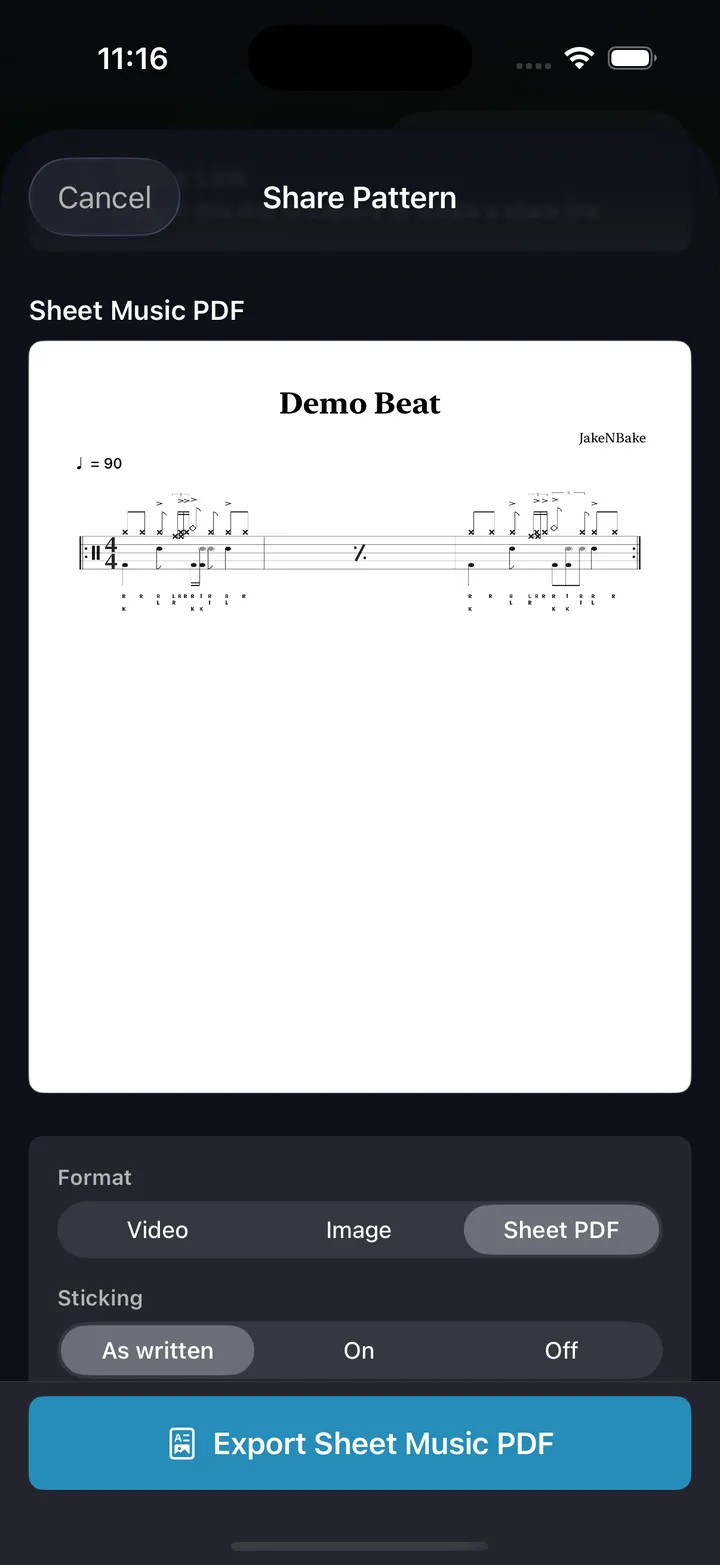
Hands-only for pad work, or drop a hi-hat foot on quarters underneath and it becomes a kit exercise. Print it as an engraved worksheet with the sticking under every note.