Hi-hat foot exercises
that start where you actually are.
Left-foot time is the layer most drummers add last and practice least. Build it as its own drill — quarters, chick on 2 and 4, offbeats, clave, splash — under whatever the hands are doing, at a tempo that is honest about the difficulty.
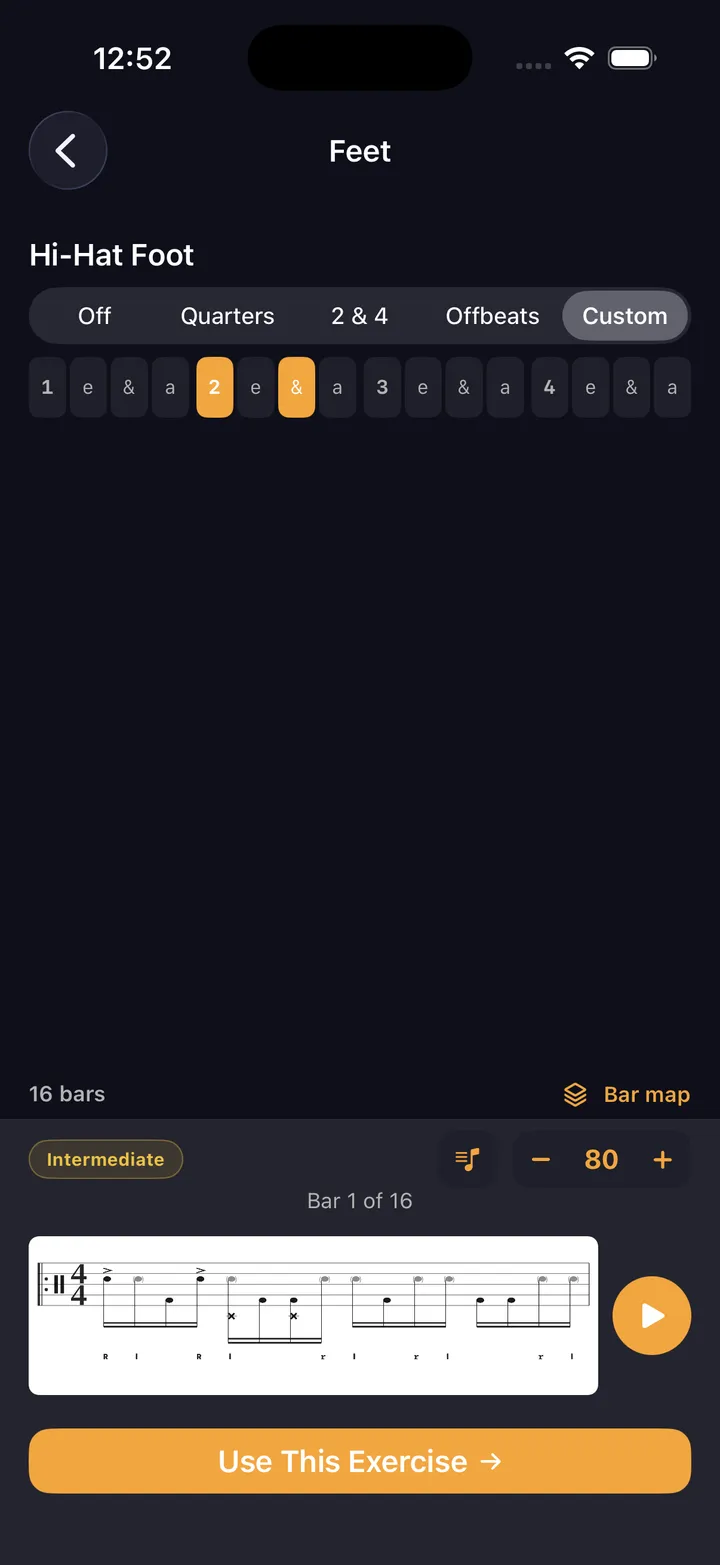
The foot is a layer, so treat it as one
A hi-hat foot is either scaffolding under something else or the thing you are working on. The builder lets it be either — check it as a layer under a sticking drill, or make it the generated part and hold the hands still.
Every foot pattern
Quarters, chick on 2 and 4, the offbeats, eighth notes, clave, and splash — as presets, or place the foot yourself tick by tick.
Difficulty that reads the tempo
A quarter-note foot at 80 is a beginner skill; the same pattern at 130 is not. Foot difficulty is banded by tempo rather than triggered flat by the presence of a pedal — so the easy entry point is actually labeled easy.
Hold the hands still
Pick a hands ostinato — eighth hats with 2 and 4, ride quarters, a bare pulse — and let the feet be the only thing that varies. Isolating one limb is the whole method.
Ladder the foot
Run a density ladder on the feet alone: quarters, eighths, triplets, sixteenths, up and back down as a pyramid. The hands never change, so there is nowhere to hide.
Or add a kick line
Hi-hat foot and kick are the same layer step, so you can build a two-foot pattern — pedal on the ands, kick on the downbeats — and practice them against each other.
Read it, not just hear it
Foot voices notate properly below the staff, so a splash-over-ride drill looks like what it is. Export it as a worksheet and take it to a lesson.
Four foot drills, in order
Tempos are starting points and targets — the ladder does the steps between.
Hi-hat foot on quarters
60 → 90 BPMThe entry point, and the one most drummers skip. Foot on every quarter, hands playing anything at all above it. The foot must be a metronome you are not thinking about — if it speeds up when the hands get busy, you have found the drill.
Chick on 2 and 4
70 → 110 BPMThe jazz default, and a different skill from quarters: the foot now has to place itself against the backbeat rather than against the pulse. Slow enough that the chick is a note, not a noise.
Foot on the offbeats
80 → 120 BPMThe ands, with the hands on downbeats. This is where the foot stops following the hands and starts opposing them. Above 120 it is genuinely an advanced coordination — the difficulty rating moves with the tempo for exactly this reason.
Splash over ride
75 → 105 BPMAn open splash on the foot under a ride pattern, so the hi-hat has to close cleanly on the next beat. It is a control drill dressed as a time drill: the length of the open sound is the thing you are practicing.
Feet Lab
The same door builds double bass work — a generated kick chain under a held hands ostinato, laddered by density.
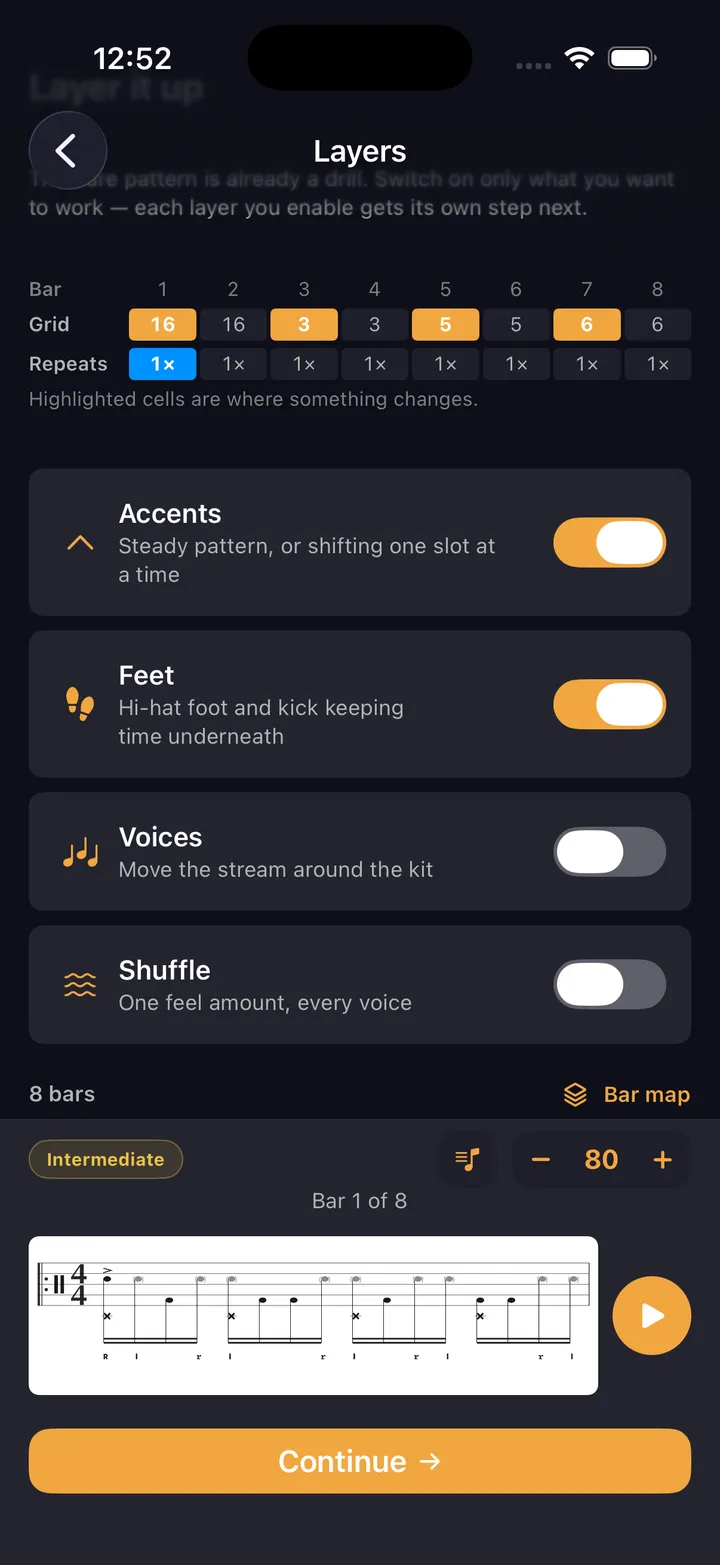
Every drummer needs
a home base.
Give the left foot its own drill.