Drum exercises
that change while you play them.
An exercise isn't a groove with the ending cut off. It repeats on purpose, isolates one mechanism, and the thing that makes it work is what moves bar to bar. DrumShed builds those — five labs, twenty built-in exercises, and a library you can browse right here.
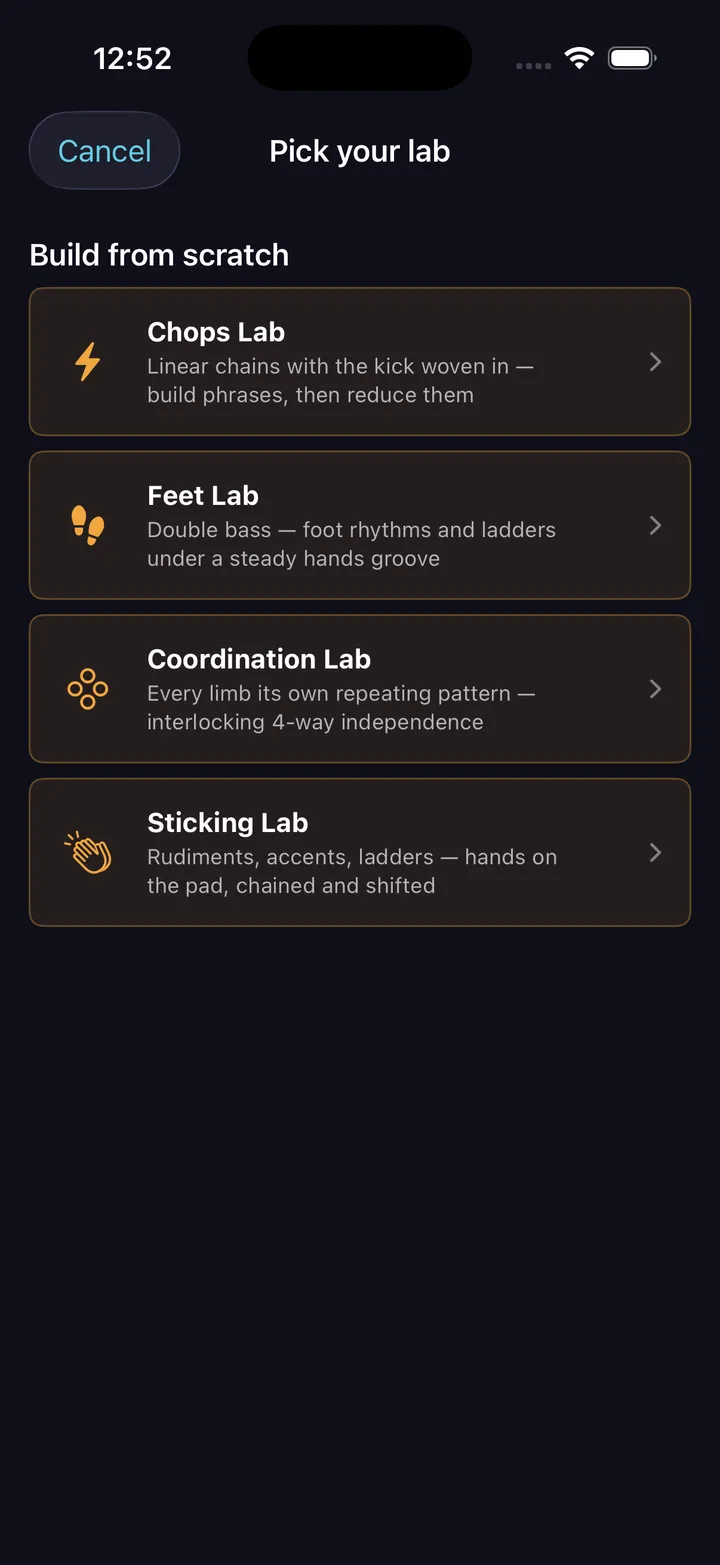
Five labs, one engine
Every lab runs the same generation pipeline — a note stream, a dimension that varies over time, a limb underlay, and a feel. What changes at each door is the vocabulary it offers you and the rules it refuses to break.
Sticking Lab
Rudiments and hand technique
Hands-only cells — singles, doubles, paradiddles, paradiddle-diddles, five-stroke rolls, or your own R/L string. It stays on the snare, because a paradiddle scattered across three toms is a tom fill wearing a rudiment’s name.
Rudiments Lab
The PAS 40, as a closed vocabulary
Pick from the forty standard rudiments by name rather than spelling them out — flams, drags, rolls, the paradiddle family — then chain them, ladder the subdivision, and put them over hi-hat time so the rudiment lives in a groove, not only on a pad.
Chops Lab
Gospel chops and linear phrasing
Kick-integrated cells chained end to end, with the reduction drill front and center — play a link four times, then three, then two, then once. Defaults to triplets and sextuplets, which is where the idiom lives.
Feet Lab
Double bass and foot control
A generated kick rhythm under a held hands ostinato. Run a density ladder or a subdivision pyramid on the feet alone — quarters up through sixteenths and back down again.
Coordination Lab
Four-way independence
Every limb carries its own repeating cell, cycling on its own length. Give the hands a two and the kick a three and they interlock polymetrically — an ostinato system you configure rather than read out of a book.
The part a preset list can’t give you
A static exercise is a photograph of a drill. The useful version is the one where something is deliberately moving — so here is each of those things, and the screen where you set it.
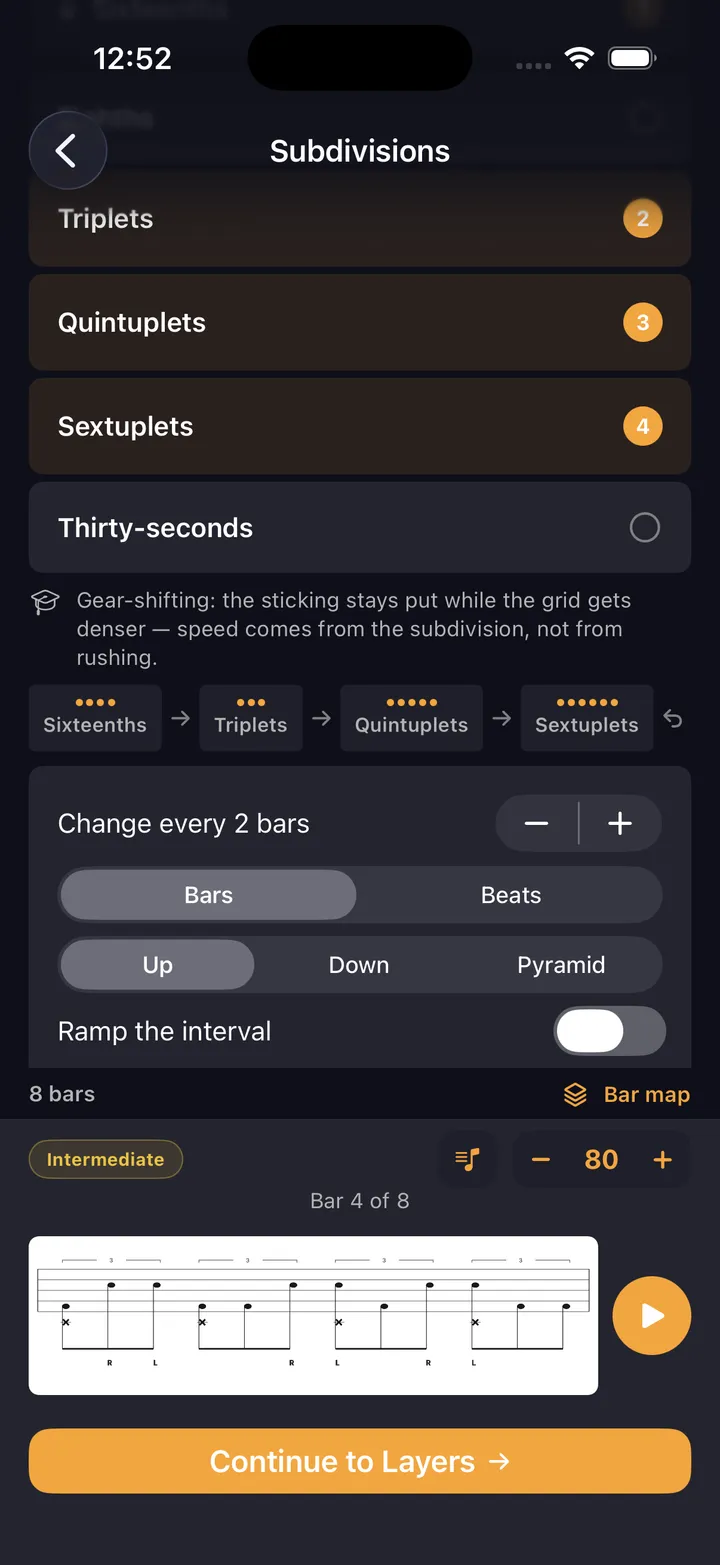
The grid moves
Subdivision ladders
Check the subdivisions you want to work — eighths, triplets, sixteenths, quintuplets — then climb them up, down, or as a pyramid that peaks and comes back. Change every bar, or every few beats.
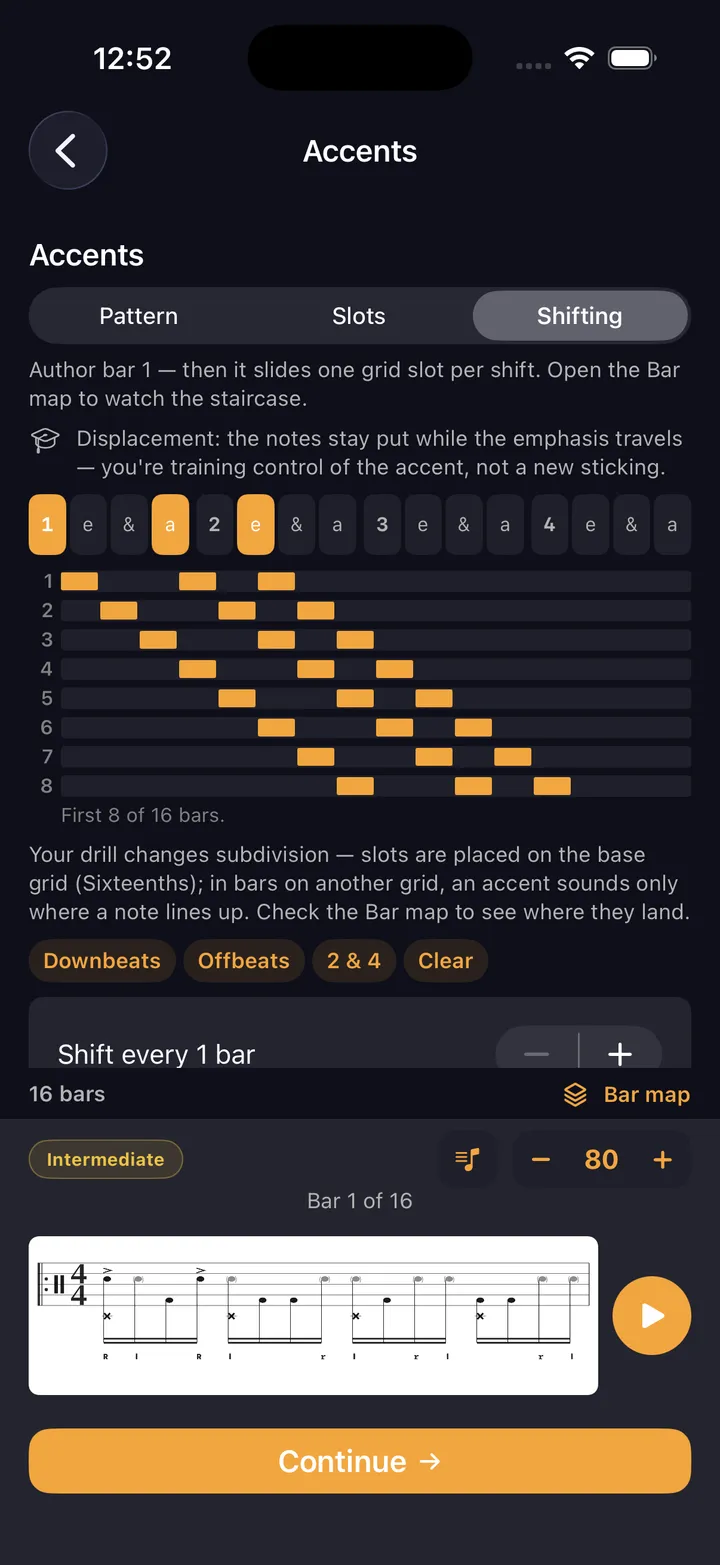
The accent moves
Shifting accents
Author one bar, then let the accent move one slot per cycle. Twelve bars later you have played it in every position in the beat, which is the whole point of displacement work.
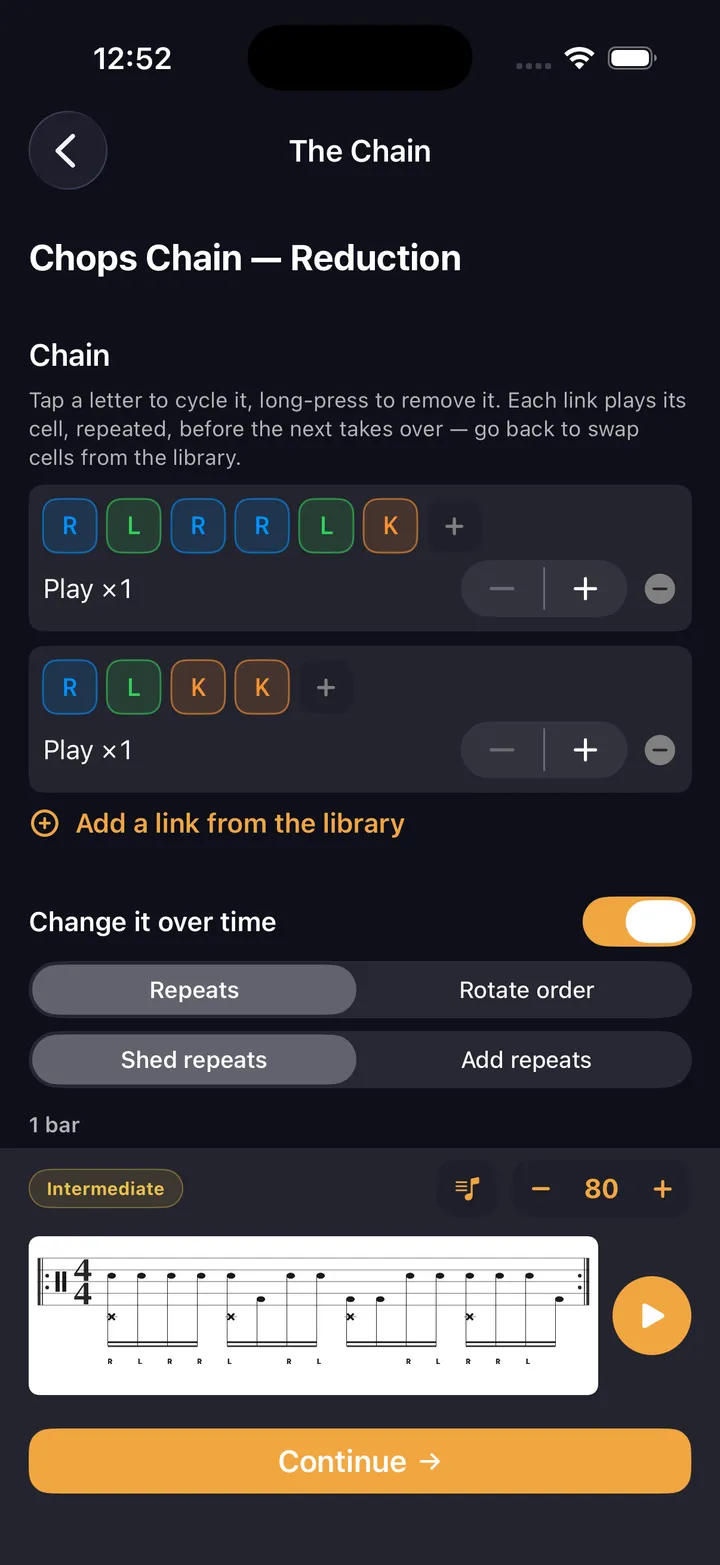
The sticking moves
Chains that rotate and reduce
Link cells together with per-segment repeat counts, then rotate the order or count the repeats down as the exercise runs — four times, then three, then two, then once.
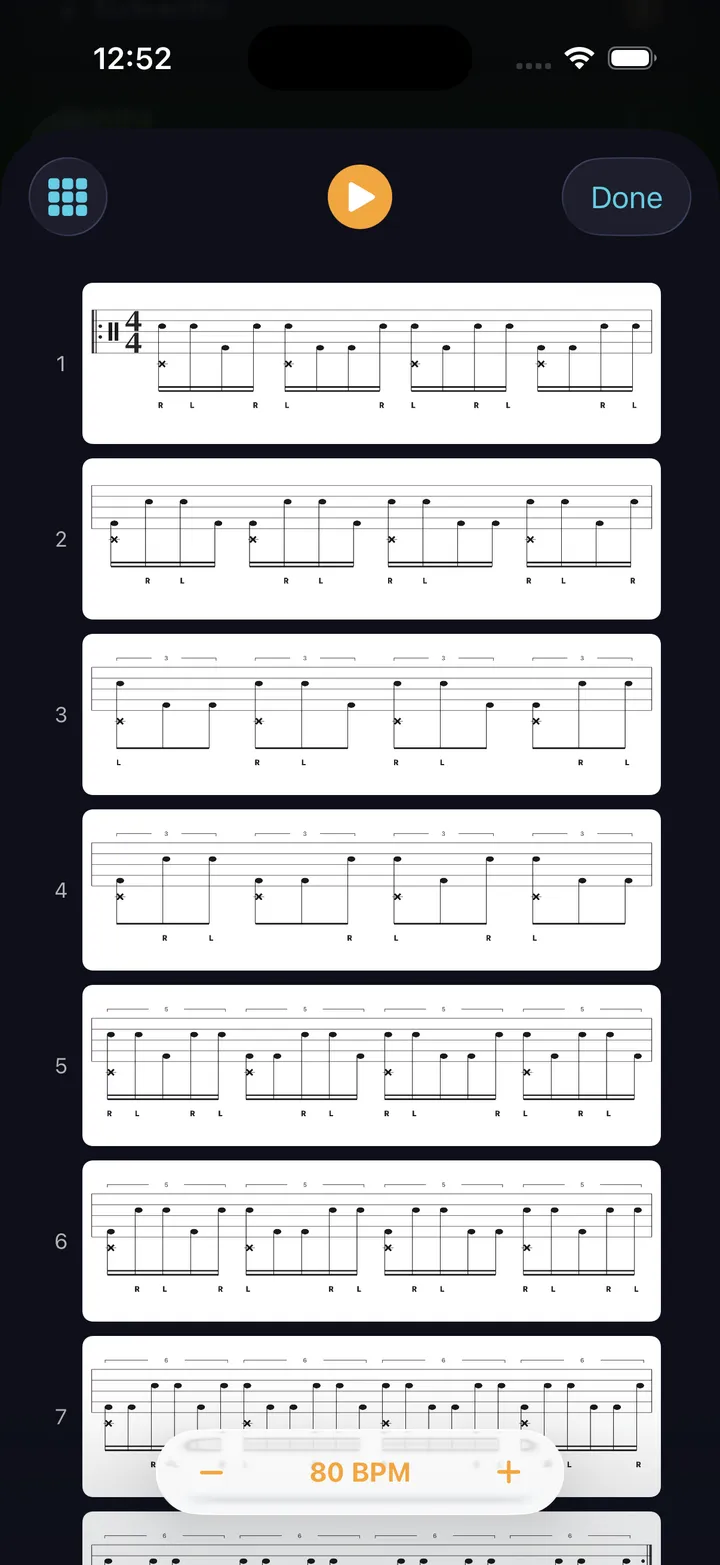
You see it first
A bar map you read before you play
Every bar of the generated exercise, stacked one row per bar. A one-slot-per-cycle accent shift reads as a staircase down the rows, so you know what you are committing to before you count it in.
Bar count you never type
A four-subdivision ladder against a three-link chain is twelve bars. The builder derives the length from the plan rather than asking you to work out the common multiple.
Rules it won't break
A rudiment stays on the snare. A hand-foot exercise has to contain a kick. When both hands are on a continuous stream the hi-hat moves to the foot — refusals in the builder, not advice in a tooltip.
Twenty built in, before you build anything
One exercise per lab per difficulty tier — twenty in total, from Single Strokes and Quarter Kicks at the beginner end through Quintuplet Burnout, Double-Kick Sextuplets and Full Polymeter Stack at the far end.
Each one is a real recipe rather than a frozen pattern: open it and the builder loads the plan that produced it, so you can move the tempo ladder, swap the sticking, or re-grid it to triplets and keep going. The difficulty badge on each is generated by the same engine that rates everything else in the app, checked against the exercise at its own practice tempo — so a preset badged intermediate is one the engine actually reads as intermediate.
On top of those, the community publishes its own. Browse every published exercise →
Browse by what it trains
Genre is a category error on an exercise. A paradiddle isn’t rock or jazz — it’s sticking control. So exercises are filed by mechanism instead.
Then actually practice it
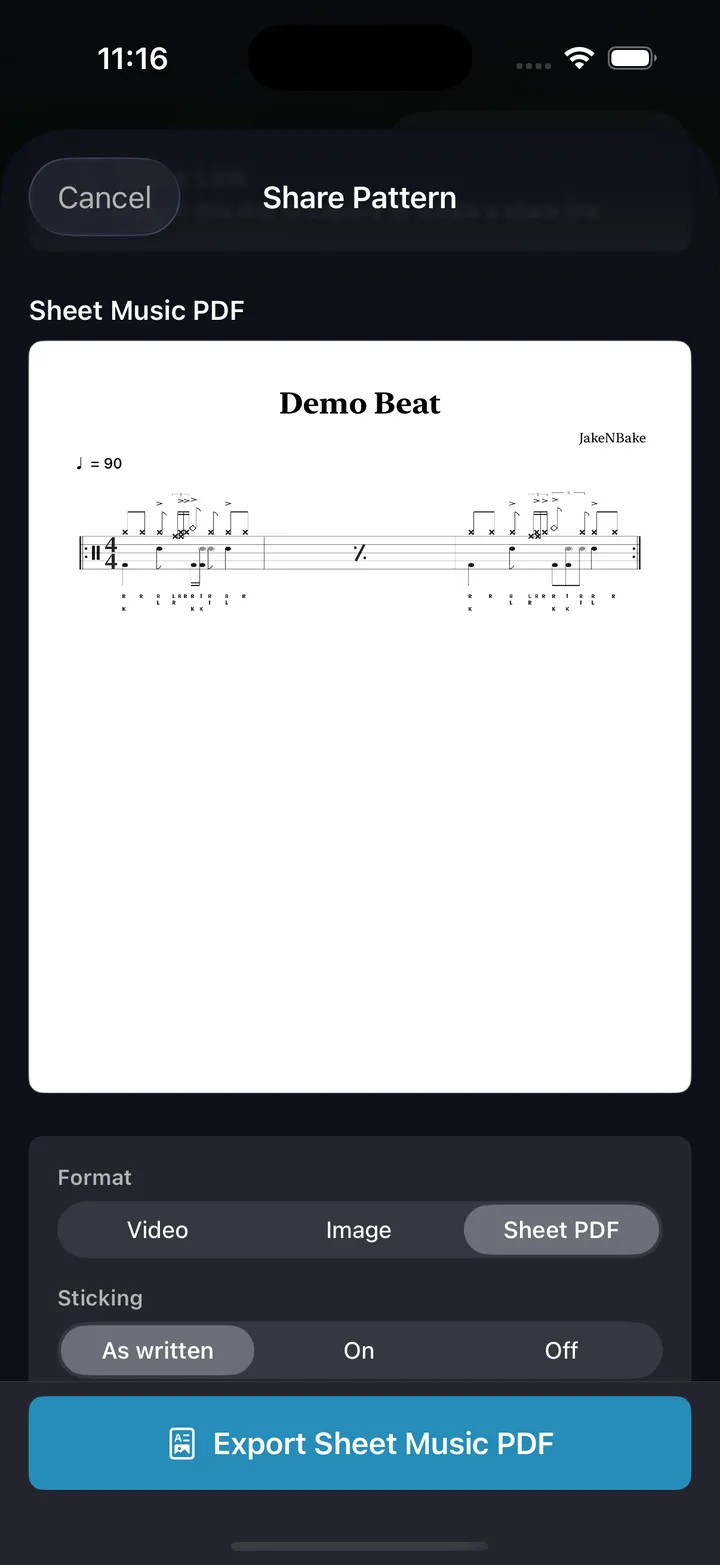
An exercise comes out of the builder as an ordinary pattern, so everything else in the app already knows what to do with it.
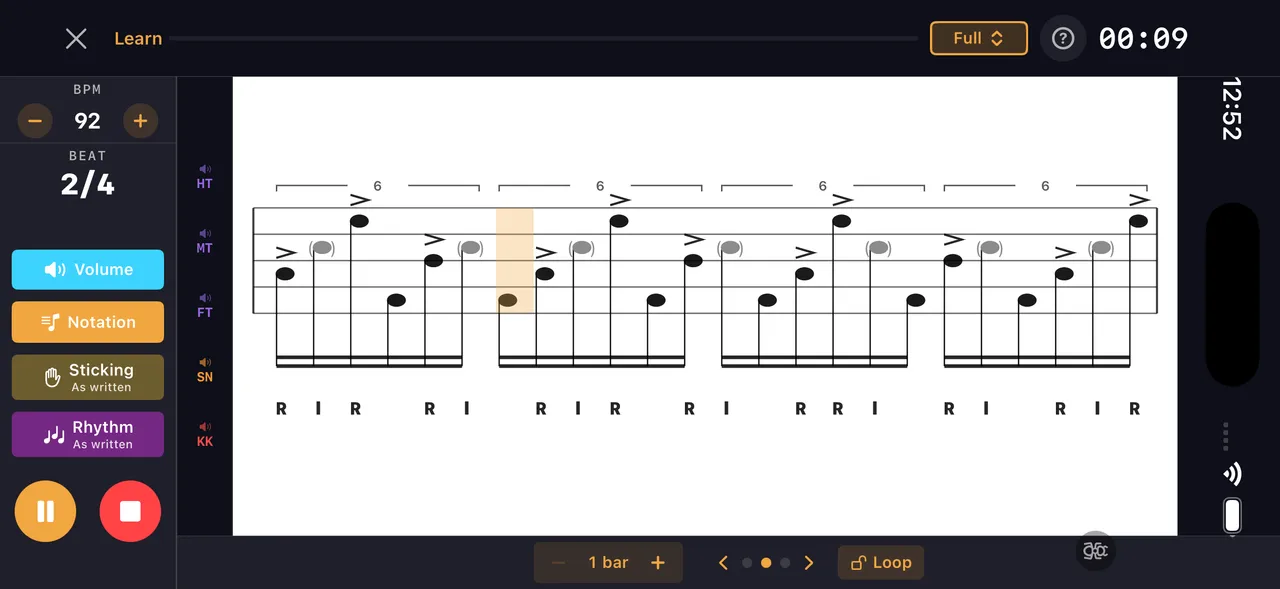
Live playback — playhead on the beat, sticking under the staff
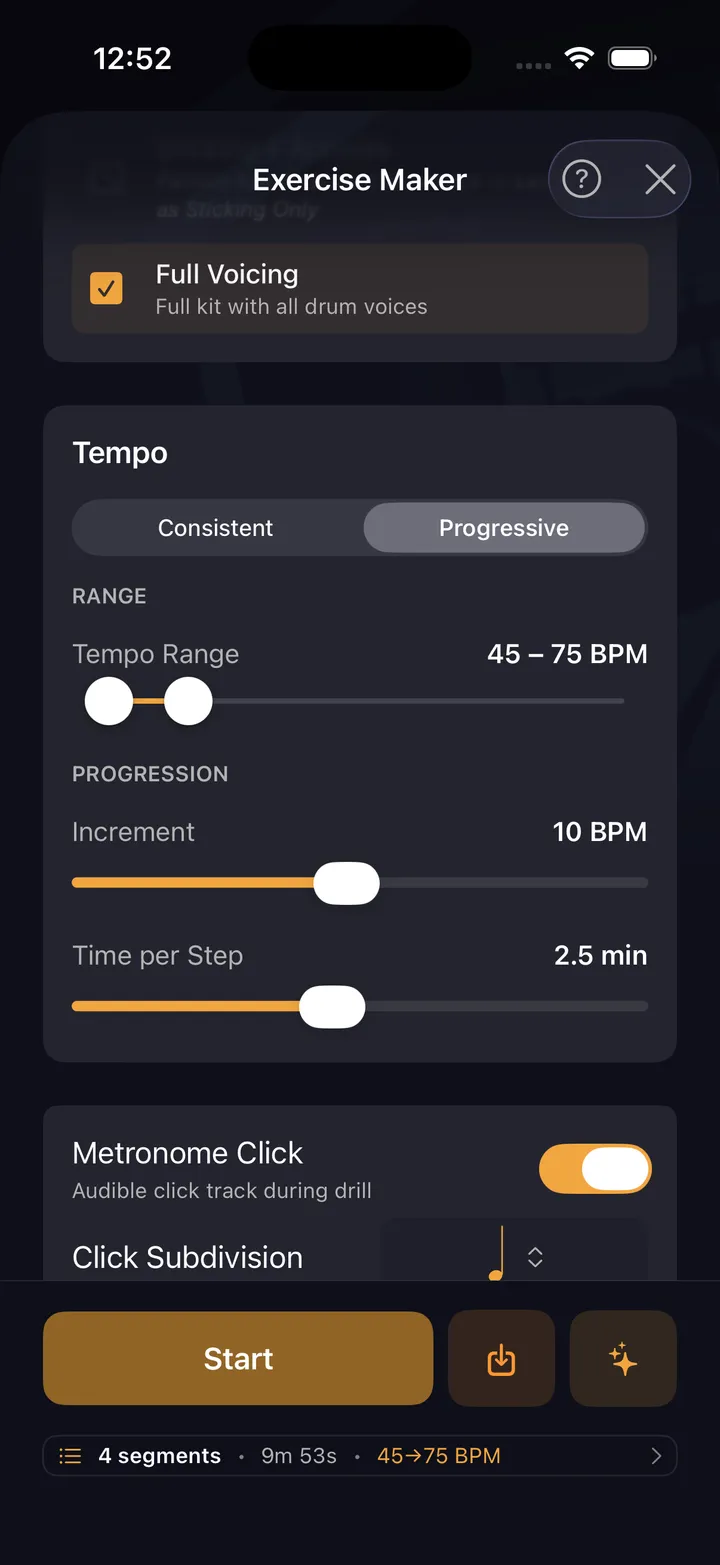
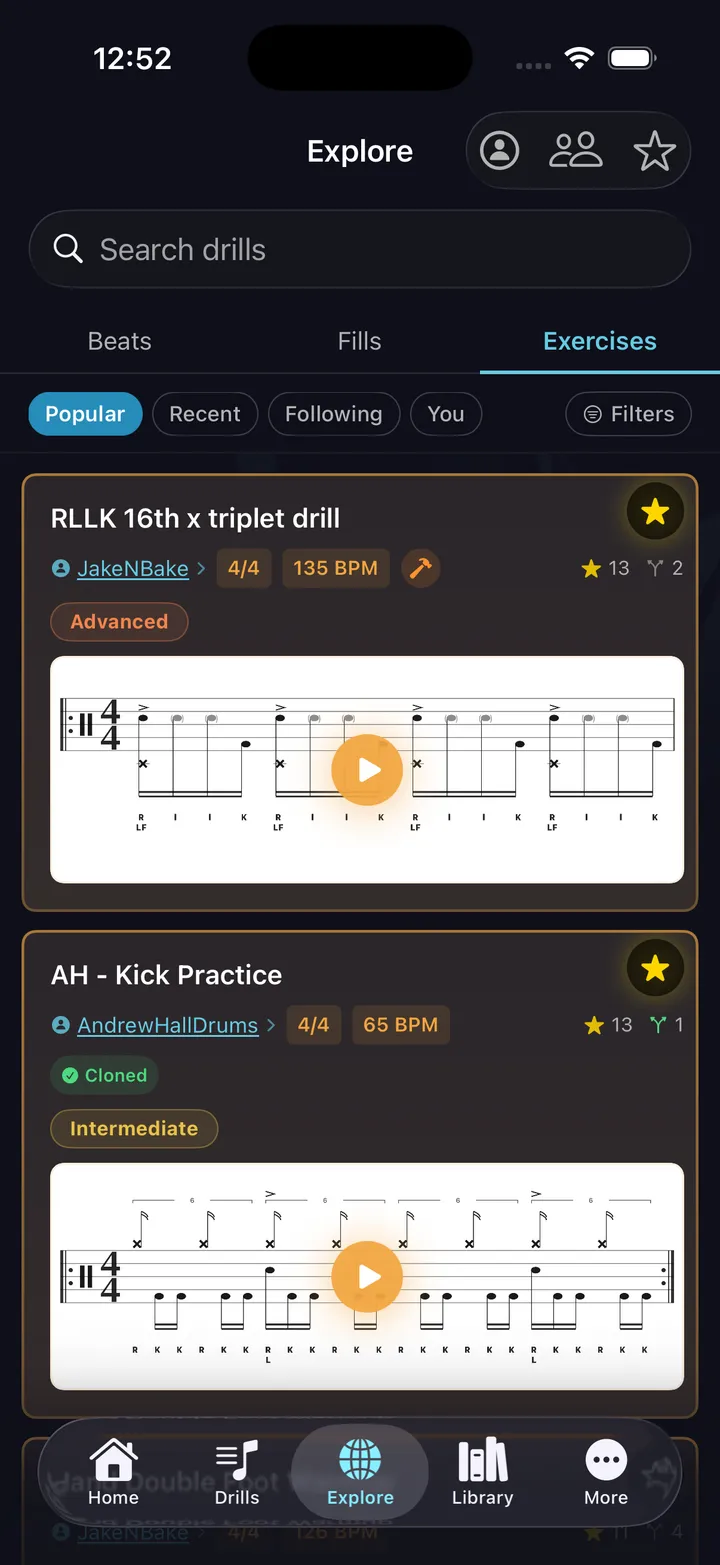
It also stacks into a hands-free session and schedules into a practice path — because the exercise you build on Tuesday is the one you should still be running on Friday.
Every drummer needs
a home base.
Build the exercise you actually need.