Snare drum exercises
on one surface, where they belong.
Rudiments, accent control, roll development, and dynamics — built as looping multi-bar exercises with the sticking under every note. Hands-only for the pad, or add a hi-hat foot and take the same drill to the kit.
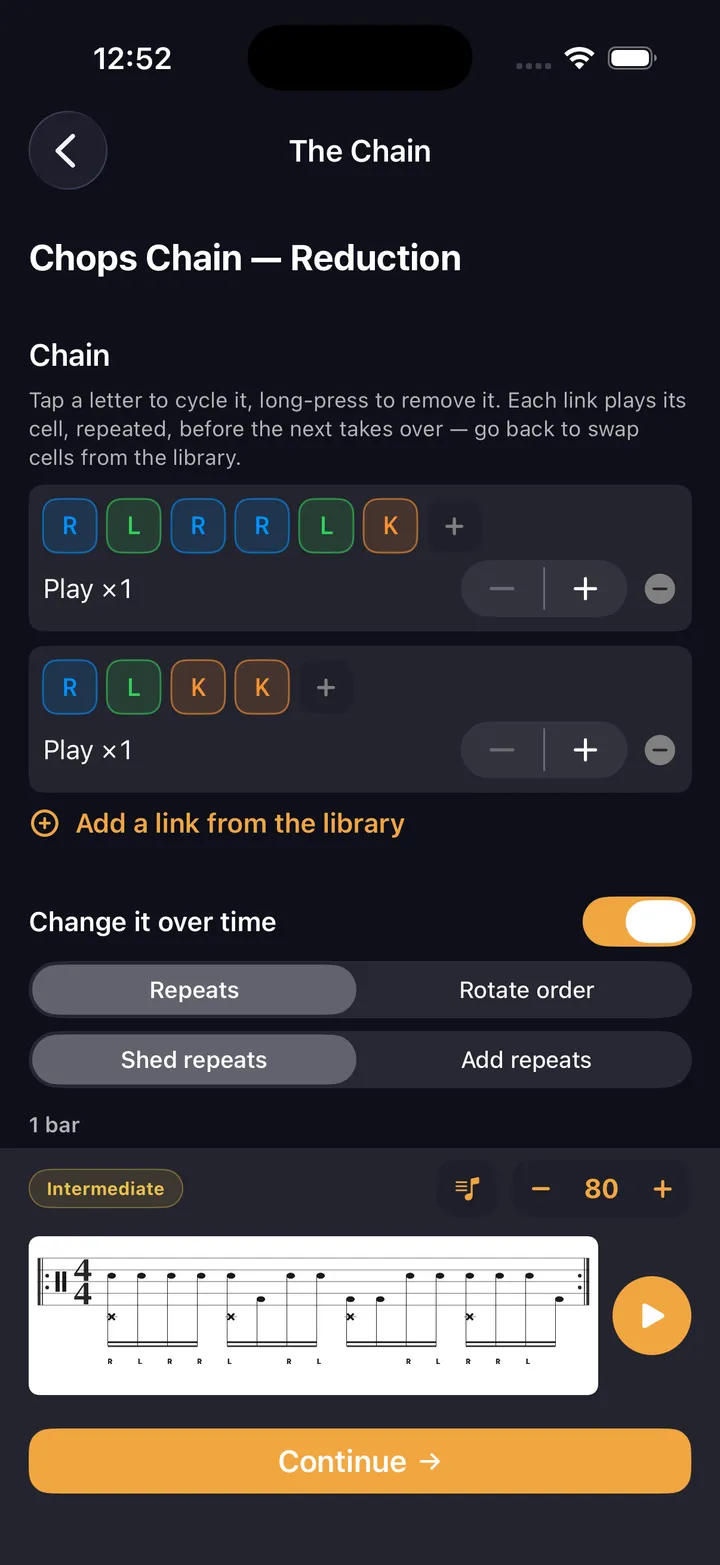
One drum, a lot of variables
Snare work looks simple on paper and is mostly about the things paper doesn’t show: which notes are quiet, where the accent falls, and whether the second stroke of a double sounds like the first.
It stays on the snare
A rudiment scattered across three toms is a tom fill wearing a rudiment's name. The Sticking Lab keeps everything on one surface unless you deliberately orchestrate it.
Three velocity levels
Accent, normal, ghost — per hit, and part of the pattern rather than an afterthought. Ghost notes render as lowercase sticking on the staff so you can read the dynamic, not just hear it.
Flams on any hit
Add a grace note to an individual stroke, or to every accent at once. The grace note carries its own velocity, which is the difference between a flam and a stumble.
Your own sticking
Type any R/L string and the builder takes it — 36,700+ stickings are in the pool, and if yours isn't, write it. Rests are allowed inside cells too.
Left-handed, properly
Set your stance once and the sticking mirrors for you everywhere. Patterns are stored right-hand-lead underneath, so anything you publish still reads correctly for the next drummer.
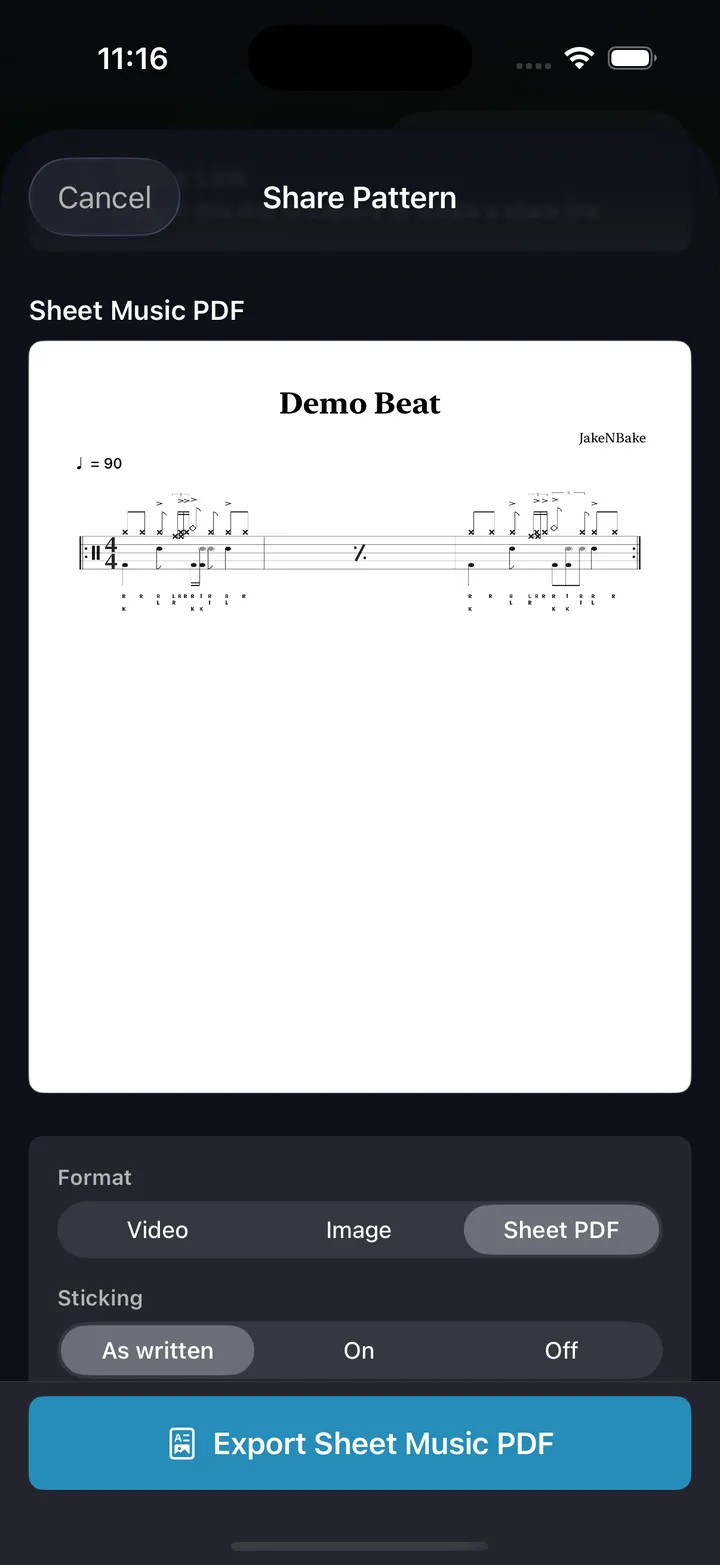
Print the worksheet
Export a multi-bar snare exercise as an engraved PDF with sticking and counting labels — the thing you actually want on a music stand.
Six snare exercises worth building
Single stroke roll, laddered
Alternating singles at a steady velocity, climbing the subdivision ladder from quarters to sixteenths and back. Uniform dynamics the whole way — the moment one hand gets louder to keep up, the drill has told you which hand it is.
Double stroke roll, no accents
RRLL, every note the same weight. Accents are forbidden here on purpose: an accent gives the weak hand something to hide behind, and the second stroke of each double is precisely what you are trying to hear.
Accent-tap control
One accent in a continuous stream of taps, and the accent walks one slot per cycle. The taps must be genuinely quiet — down at ghost level, not merely softer. Sixteen bars puts the accent through every position.
Paradiddle family, chained
Single paradiddle, then double, then inverted, then paradiddle-diddle, chained with per-segment repeats. Rotate the chain so each one takes a turn starting the bar, because a rudiment you can only enter from the top is half learned.
Five and seven stroke rolls
The short rolls, placed against a pulse rather than floating. Build them at a tempo where the diddles are clean and let the tempo ladder take them up in steps instead of leaping to the speed you want.
Flam rudiments
Flam taps, flam accents, and Swiss triplets — with flam control on any individual hit. The grace note is a separate hit at its own velocity, so you can hear whether the flam is tight or flapping.
Read it while you play it
Sticking under the staff, counting syllables above it, and the playhead on the bar you’re in — on a phone propped on the pad, or an iPad on the stand.
Every drummer needs
a home base.
One drum. Every permutation.