Easy drum beats
you can hear and play.
Five beginner drum beats, from the money beat to your first syncopation — each one written in real notation you can play, loop, and slow down right on this page.
Every beat below is a small edit to the one before it — that's the fastest way to build a vocabulary. Press play on each example, watch the playhead move through the notation, and count "1 & 2 & 3 & 4 &" along with the hi-hat. New to reading the staff? Start with our guide to reading drum notation — these examples use the same commonly accepted conventions.
1. The money beat
The most-played drum beat in popular music: hi-hat on every eighth note, kick on beats 1 and 3, snare on the backbeats 2 and 4. Thousands of songs run on exactly this. Learn it first — every other beat on this page is a small edit to it.
2. Four on the floor
Put the kick on every beat and you have the pulse of disco, house, and half of modern pop. The snare stays on 2 and 4 — your right foot just stops skipping beats.
3. The "& of 3" kick
Your first syncopation: add one kick between beats 3 and 4 (the "&"). That single off-beat note is what makes a beat start to groove instead of march.
4. Double kick up front
Two kicks in a row — beat 1 and the "&" right after it. The rhythm of countless rock and pop songs. Keep both kick notes even; don't rush the second one.
5. Half-time groove
Move the snare to beat 3 only and the same bar suddenly feels twice as slow and twice as heavy. Half-time is a feel, not a tempo change — the hi-hat keeps moving at the same speed.
How to practice a new beat
Break it into layers: hi-hat alone, then hi-hat + snare, then add the kick last. Play each layer until it's boring before stacking the next. Use a metronome from day one — 60–80 BPM — and loop short: one bar, over and over, is worth more than stumbling through eight. When the beat feels automatic, add your first easy drum fill at the end of every fourth bar, and try the swung version of beat 1 in our shuffle guide.
Easy drum beats FAQ
What is the easiest drum beat for a beginner?
The "money beat": hi-hat on every eighth note, kick drum on beats 1 and 3, snare on beats 2 and 4. It uses one limb at a time per decision, it fits thousands of real songs, and every common rock and pop beat is a small modification of it.
What tempo should a beginner practice drum beats at?
Start around 60–80 BPM with a metronome — slow enough that you can place every note deliberately. Only raise the tempo once you can play the beat for a full minute without tension or flams between the hands. Speed comes from control, not effort.
How long does it take to learn a basic drum beat?
Most people can play the money beat slowly within their first sitting. Making it feel steady and relaxed at multiple tempos usually takes a couple of weeks of short daily practice — ten focused minutes a day beats one long weekend session.
Should I count out loud while learning beats?
Yes — counting "1 & 2 & 3 & 4 &" out loud ties the limbs to the pulse and exposes exactly where you lose the grid. DrumShed can print those counting syllables above the notation and speak a count-in before the pattern starts.
Practice these in DrumShed
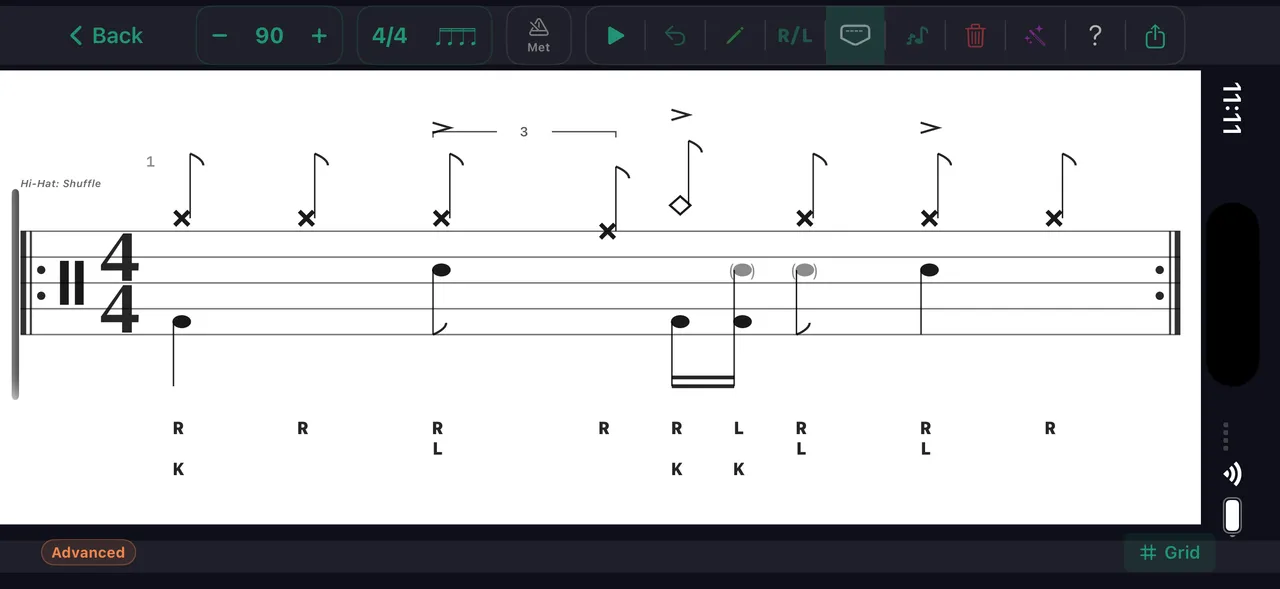
Every beat here lives in the app too — loop it at any tempo, watch grid or notation view with a moving playhead, follow the spoken count-in, and build your own variations in the Beat Builder when you're ready. When one is worth owning, tap Learn This and it becomes a day-by-day tempo ramp on a practice path.
Every drummer needs
a home base.
Five beats in, you're drumming.