How to play drums
— the first five steps.
A beginner's road map from sitting down at the kit to playing your first beat and fill, with playable examples at every stage so you can hear exactly what you're aiming for.
Drumming has a famously friendly beginning: within an hour you can play something that sounds like music. The order below is the one that actually works — posture and grip, then time, then coordination, then vocabulary. Each step has a playable example, and each links to a deeper guide when you're ready for it.
Parts of a drum kit
A standard five-piece kit, and what each piece is for:
1.Sit down and meet the kit
Set the throne high enough that your thighs slope slightly down, with your kick and hi-hat pedals under the balls of your feet. Snare between your knees, tilted slightly toward you. Everything you play should be reachable without leaning — if you're stretching, move the drum, not your spine.
2.Hold the sticks and play even strokes
Use matched grip: hold each stick between thumb and index finger about a third of the way up, with the remaining fingers wrapped loosely. Loose is the whole secret — a tight grip kills rebound and gives you blisters. Then play slow alternating strokes and make both hands sound identical.
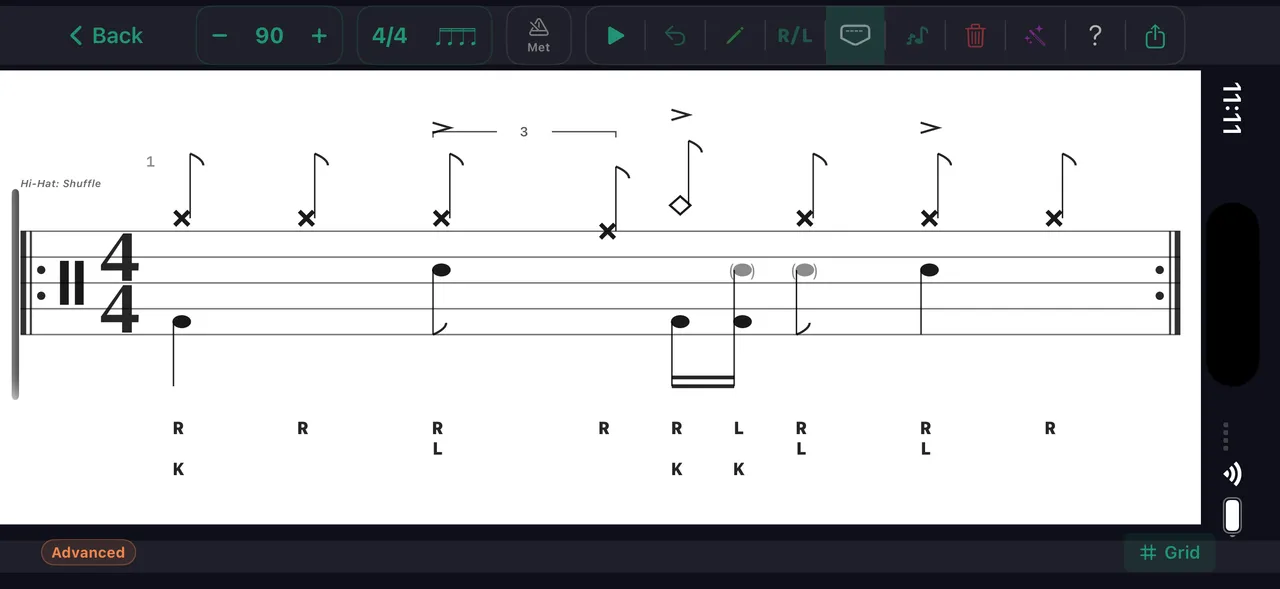
Here's that stroke exercise — alternating right and left on the snare, one note per beat. Slow, even, relaxed:
3.Turn on a metronome
Before any beat, get comfortable placing notes with a click at 60–80 BPM. This is the single habit that separates drummers who groove from drummers who merely play the right notes. Every exercise from here on should have a click running underneath it.
Two limbs first: hi-hat on every beat with your stick, kick on beats 1 and 3 with your foot. Getting hand and foot to land together is the coordination that makes everything later possible.
4.Learn your first beat
Layer it: hi-hat alone, then add the snare on beats 2 and 4, then add the kick on 1 and 3. Each layer should feel boring before you stack the next one. That combination is the money beat, and it will carry you through thousands of songs.
That's your first beat. Four more variations of it — four-on-the-floor, syncopated kicks, half-time — are laid out in easy drum beats.
5.Add fills and start reading
Once the beat is automatic, play three bars of groove and a simple fill in the fourth. Around the same time, start learning to read notation — it turns every method book, chart, and transcription on the internet into material you can use. Start with four easy fills that land on beat 1, and read the staff from scratch in how to read drum notation.
Where to go next
Beginner drumming FAQ
How long does it take to learn to play drums?
Most people can play a recognizable beat in their first session and play along to simple songs within a month or two of short daily practice. Sounding genuinely good — steady time, relaxed hands, dynamics — is a matter of a year or two of consistent practice. Ten focused minutes daily beats three hours on Sunday.
Can I learn drums without a drum kit?
Yes, for a surprising amount of it. A practice pad or even a pillow covers hand technique, rudiments, and reading; a metronome covers timekeeping. You need a kit (or electronic kit) to coordinate all four limbs and to learn dynamics between drums, but the hand and reading work transfers completely.
What should I learn first on the drums?
In order: how to hold the sticks and play even strokes, keeping time with a metronome, the money beat (hi-hat eighths, kick on 1 and 3, snare on 2 and 4), then simple fills, then reading notation. Coordination before speed, and time before either.
Do I need drum lessons to learn?
Not strictly — plenty of drummers are self-taught, and structured practice material plus honest self-assessment gets you a long way. A teacher's real value is catching bad technique early, especially grip and tension, which is much harder to fix later than to learn right.
How do I practice drums quietly?
A practice pad for hands, an electronic kit with headphones for full-kit work, or low-volume mesh heads and cymbals on an acoustic kit. Rudiments, reading, and timekeeping — most of what a beginner needs — can all be done at conversation volume on a pad.
Practice it in DrumShed
DrumShed gives every step above a home: a free metronome, drills that loop at your tempo with a spoken count-in, notation and grid views with a moving playhead, and a practice history that shows the habit forming. See the beginner on-ramp for a 30-day plan.
Every drummer needs
a home base.
Sit down. Count four. Play.