Flams
— one fat note, two hands.
The grace-note rudiment that thickens accents and backbeats. Alternating flams, flam taps, and flams inside a groove — all playable, with sticking.
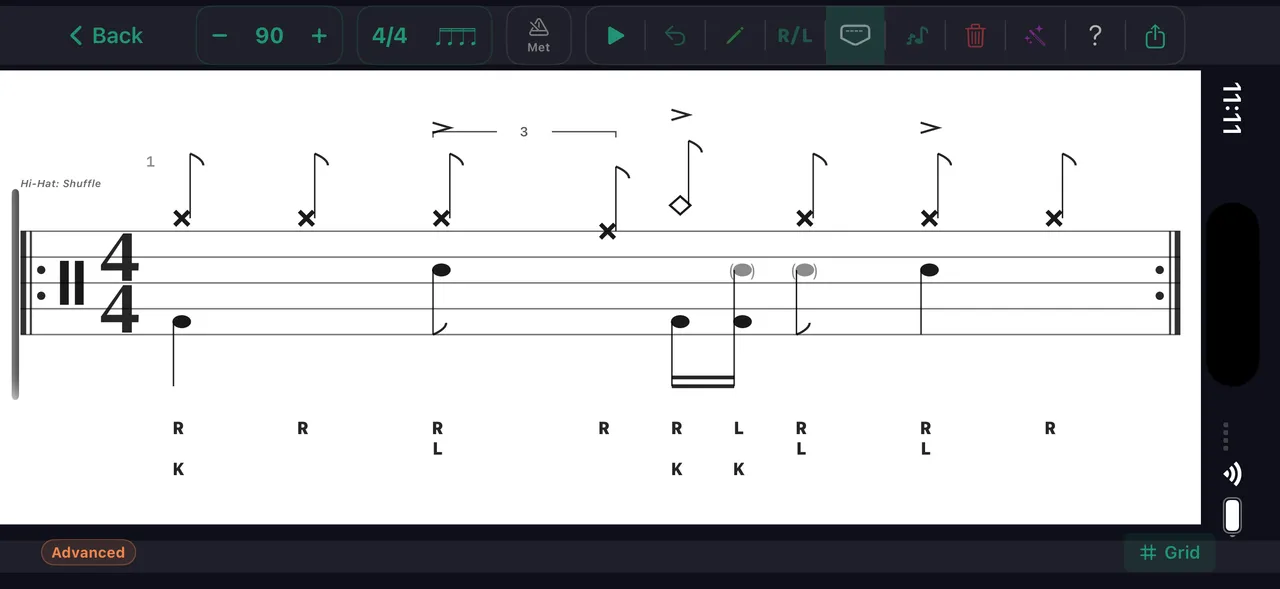
In notation a flam is the small grace note tucked in front of a main note, joined by a slur — you'll see it in each example below. The grace note is quiet and early by a hair; the primary note is the real landing. Get comfortable reading the staff first with the notation guide, then work these three stages.
Step 1: alternating flams
One flam per beat, alternating which hand plays the primary stroke (the sticking letter marks the primary hand). Set the grace-note hand low, the primary hand high, and drop both together — the height difference makes the flam for you.
Step 2: flam taps
Flam, then a tap from the same hand that just played the primary note — R-flam, R-tap, L-flam, L-tap. The tap keeps each hand honest: no time to freeze after the flam. Keep the taps soft and the flams proud.
Step 3: flam the backbeat
The payoff: drop a flam onto the snare backbeats of an ordinary groove and beats 2 and 4 suddenly sound twice as wide. This is the sound of countless rock choruses — same beat, fatter snare.
Flam FAQ
What is a flam in drumming?
Two strokes played almost — but not quite — together: a soft grace note from one hand landing a split second before a full primary stroke from the other. Instead of one clean "tap" you get a thicker "fl-AM". It fattens accents, backbeats, and fill endings.
How far apart should the two notes of a flam be?
Close enough to read as one fat note, far apart enough that it isn't a unison. The practical control is stick height: start the grace-note hand an inch or two above the head and the primary hand at full height, then drop both together. The height difference creates the timing gap automatically.
What is a flam tap?
A flammed stroke followed by a tap from the same hand that just played the primary note, alternating: flam-tap right, flam-tap left. It's the standard next step after basic alternating flams, because it forces each hand to recover from the flam and immediately play again.
Why do my flams sound like two separate notes?
The grace note is starting too high, making the gap too wide. Keep the grace-note stick low — barely off the head — and think of the two hands as one motion with staggered heights, not two separate hits. Slow practice in front of a mirror fixes flams faster than speed ever will.
Drill it in DrumShed
Loop each stage slowly in the app — exercise mode repeats it back-to-back, pad style — watch the grace notes in the notation view, and bring the tempo up only when every flam sounds like one note. Then mix flams with accent work for full dynamic control.
Every drummer needs
a home base.
Make one note sound huge.