The double stroke roll
— two per hand, dead even.
R-R-L-L: the rudiment that unlocks rolls, paradiddle vocabulary, and effortless-sounding speed. Playable notation from slow open doubles to kit application.
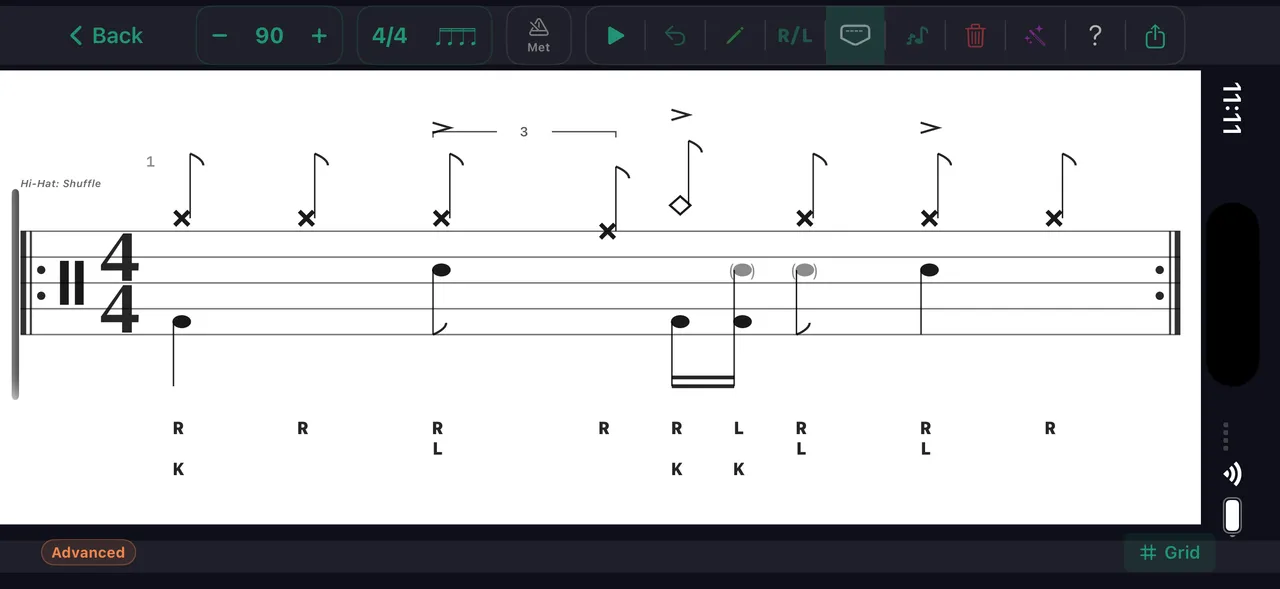
The double stroke roll looks like a shortcut — one hand motion, two notes — and that's exactly why it's hard: the free second note wants to be quieter and late. The entire rudiment is the discipline of making both notes identical. Master singles first (see the single stroke roll), then work these four steps.
Step 1: open doubles, full strokes
Eighth-note spacing at 60 BPM, and here's the rule: no bounce allowed. Both notes of each pair are deliberate, equal wrist strokes. This feels absurdly slow — it's building the evenness that rebound will later try to steal.
Step 2: sixteenth-note doubles
The roll proper: R-R-L-L as sixteenths, counted "1 e & a". Listen hard for the seam between hands — R-R-L is where the timing usually hiccups. If you hear galloping, slow down until it's a straight line of notes again.
Step 3: accent the pair
Lean on the first note of each pair and let the second sit underneath. Practicing the accent placement on purpose gives you control over what rebound does automatically — later, reverse it and accent the second note to bulletproof the weak stroke.
Step 4: split the doubles across the kit
Right-hand doubles stay on the snare while left-hand doubles answer on the toms. Suddenly the rudiment is a fill — this call-and-answer shape is all over gospel and fusion playing, and it's a great test that your doubles survive the trip between drums.
Double stroke roll FAQ
What is a double stroke roll?
The second fundamental rudiment: two strokes per hand, R-R-L-L, played perfectly even. At slow tempos both notes are deliberate wrist strokes; at speed, the second note comes from controlled rebound. It powers the five, seven, and nine stroke rolls, paradiddle variations, and most "how did they do that" fill moments.
Why is my second stroke weaker than the first?
Because rebound gives you the second note for free — at a fraction of the volume. The fix is slow practice where both notes are full, intentional strokes of equal height. Accenting the second note of each pair (R-r-L-l becomes r-R-l-L) for a few minutes a day is the classic corrective.
What is the difference between open and closed rolls?
An open (double stroke) roll keeps every note distinct — you can hear each of the two strokes per hand. A closed (buzz or press) roll lets each stroke multiple-bounce into a sustained crush. Open rolls are rhythm; closed rolls are texture. Learn open first: buzz control is much easier once clean doubles exist.
How do I speed up my double stroke roll?
Alternate short bursts at a slightly-too-fast tempo with long comfortable stretches at a clean one, always relaxed. Let the fingers close around the rebound for the second note instead of forcing it from the wrist. If evenness collapses, the tempo has outrun the technique — drop back down.
Drill it in DrumShed
Loop each step in exercise mode — no groove bars, just the doubles repeating — creep the metronome up over days, and keep the streak alive. Doubles feeling solid? Combine them with singles in the five stroke roll or the paradiddle.
Every drummer needs
a home base.
Two per hand. No freebies.