Easy drum fills
that land on beat 1.
Four beginner drum fills written as two-bar phrases — a bar of groove, then the fill, resolving to a crash. Play them, loop them, and slow them down right here.
A fill only makes sense in context, so every example below is two bars: the money beat in bar 1 (with the crash the fill resolves onto), then the fill in bar 2. Loop the phrase and the crash lands right where the fill delivers you — beat 1. Use the bar selector to study each bar's notation, and see how to read drum notation if the staff is new to you.
1. The eighth-note snare fill
The simplest fill that works: four alternating eighth notes on the snare over beats 3 and 4, then land the crash on beat 1. If you can play the money beat, you can play this tonight. The whole job of the fill is to arrive on that crash without speeding up.
2. Sixteenths on beat 4
Keep the groove going one beat longer and squeeze four sixteenths (R-L-R-L) into beat 4 only. Short fills like this are what you actually hear on records — one beat of interest, then straight back to the pocket.
3. Sixteenths around the kit
The classic full-bar fill: four sixteenths each on snare, high tom, mid tom, floor tom — a single-stroke roll walked around the drums. Practice the sticking slowly; the hands keep alternating R-L the whole way so the move between drums happens mid-hand-pattern.
4. Two and a tom
Two snare sixteenths into one floor-tom eighth ("1-e-&"), twice. It sounds far more advanced than it is — the gap on the "a" is what gives it shape. A great first taste of leaving space inside a fill.
The one rule of fills
Nobody remembers a slightly plain fill; everybody notices a fill that rushes. The groove's job continues straight through the fill — count "1 e & a" out loud, keep the metronome on, and treat the crash on beat 1 as the fill's destination rather than its escape hatch. When these four feel easy, raid the fill library for hundreds more, or build your own in the Fill Builder.
Easy drum fills FAQ
What is the easiest drum fill for a beginner?
Four alternating eighth notes on the snare (R-L-R-L) over beats 3 and 4, landing on a crash on beat 1 of the next bar. It requires no new limb coordination — just steady hands and the discipline to keep the tempo while the beat drops out.
When should I play a drum fill?
At the ends of phrases — most commonly every 4 or 8 bars, leading into a section change like a verse to a chorus. A fill is punctuation, not decoration: it announces that something is about to happen, then resolves, usually onto a crash on beat 1.
Why do I speed up when I play fills?
Because the timekeeping voice (usually the hi-hat) stops, and excitement fills the gap. Practice fills with a metronome and count out loud through the fill. Slowing the practice tempo until the fill feels boring is the fastest cure.
Do drum fills have to end with a crash?
No, but resolving to a crash on beat 1 is the strongest and most common landing, which is why beginners should learn it first. As you advance you'll end fills on toms, on the snare, or straight back into the hi-hat with no crash at all.
Practice these in DrumShed
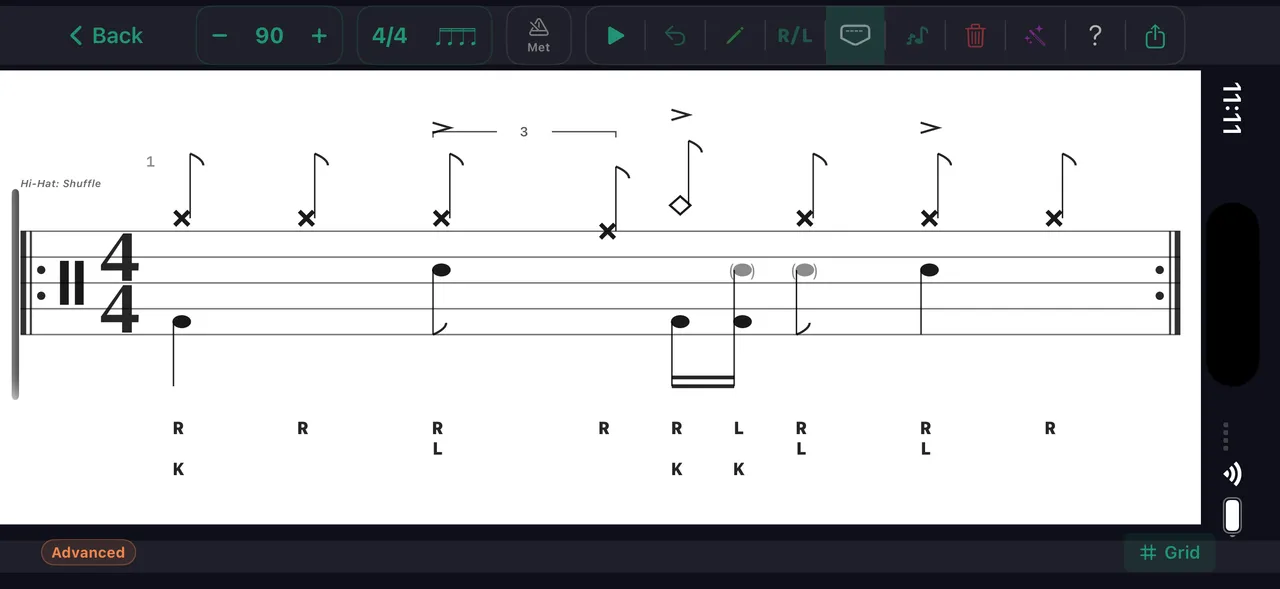
Load any fill in the app to loop it at your tempo, watch the sticking labels, and let Learn mode build the phrase up in stages before you take it to full speed. Then tap Learn This to ramp it day by day on a practice path until it lands at full tempo.
Every drummer needs
a home base.
Groove, fill, crash — repeat.