Drumless tracks,
genre by genre.
Every built-in backing track in DrumShed, sorted the way a drummer looks for one: by genre, then by tempo, with what each one is for. All royalty-free, all with the drums already separated and a click on the grid.
The library
Tempos are measured from each track’s grid, so a row reads the way the click will feel.
Slow rock, classic rock, rock, half-time rock, indie rock
The first backbeat, eighth-note hats, the quarter-note beat, fills that land on 1. Where beginner and novice paths end their days.
Simple funk, funk, mid-tempo funk, funk-rock, New Orleans second line
Sixteenth-note hats, ghost notes, linear patterns, the hand-foot ladders, anticipations and pocket.
Jazz ballad, jazz swing, medium-up swing, fast jazz swing
The ride pattern and the chick, comping, brushes on the ballad, single-stroke speed and triple strokes on the fast swing.
Gospel, gospel shuffle, swung gospel, gospel shed
Church grooves, hand-foot medleys, linear fours and sixes, and shed tracks for the chops ladders.
Bossa nova, samba, cha-cha, son montuno, Afro-Cuban in 4, cumbia, forró, reggaeton, salsa
Clave, the tumbao and cascara, samba feet, baião, and the fastest hands on the shelf on the salsa.
Blues shuffle, Texas shuffle
The shuffle, double paradiddles, triplets, kick doubles under a swung hat.
Motown soul, neo-soul
Accent and tap, the kick on the beat, hands apart, and the neo-soul pocket with the snare laid back.
Boom-bap, lo-fi, trap
Ghost notes, the kick weave, the half-time pocket, trap hats.
Metal, mid-tempo metal
Double strokes, flams, kick doubles on one foot, the double-bass ladder, blast and gallop.
Drum and bass
One-hand speed runs, triple strokes, kick doubles at tempo, the amen break.
Punk
The d-beat, the tom beat at speed, single-stroke endurance.
Afrobeat
Subdivision mixing, the Allen skeleton, the hand-foot medley over a long form.
Pop ballad, disco
The hi-hat foot, the first groove, four on the floor, locking to a click.
One drop, ska
The one drop, rockers and steppers, the upstroke skank.
Country train beat, country shuffle
The train beat, the two-step, the honky-tonk shuffle.
Fusion
Odd groupings over a straight pulse; the subdivision-mixing paths.
Picking a track for the drill you just did
Match the feel first, then the tempo. A straight-eighth drill wants rock or pop; sixteenths want funk, neo-soul or gospel; a shuffle drill wants blues, the gospel shuffle or a swing. Then pick the slowest track that still feels like the style, play it clean, and move up the shelf — the same genre usually has a faster take waiting.
Every track has the drums on a fader, so the first pass can be with the original part in at a quarter to hear where it sits, and the next pass with it out. Half speed at the same pitch is there for the fast ones; a bar range can loop inside a session next to the drill it came from.
What you can upload, and who can hear it
- Audio files you have the rights to use for your own practice — your band’s recordings, demos, rehearsal takes, lesson material. MP3, M4A, WAV or FLAC, up to 15 minutes. We don’t accept links from streaming services.
- Private by construction. Uploads are never shared, listed, or searchable, and they’re deleted with your account.
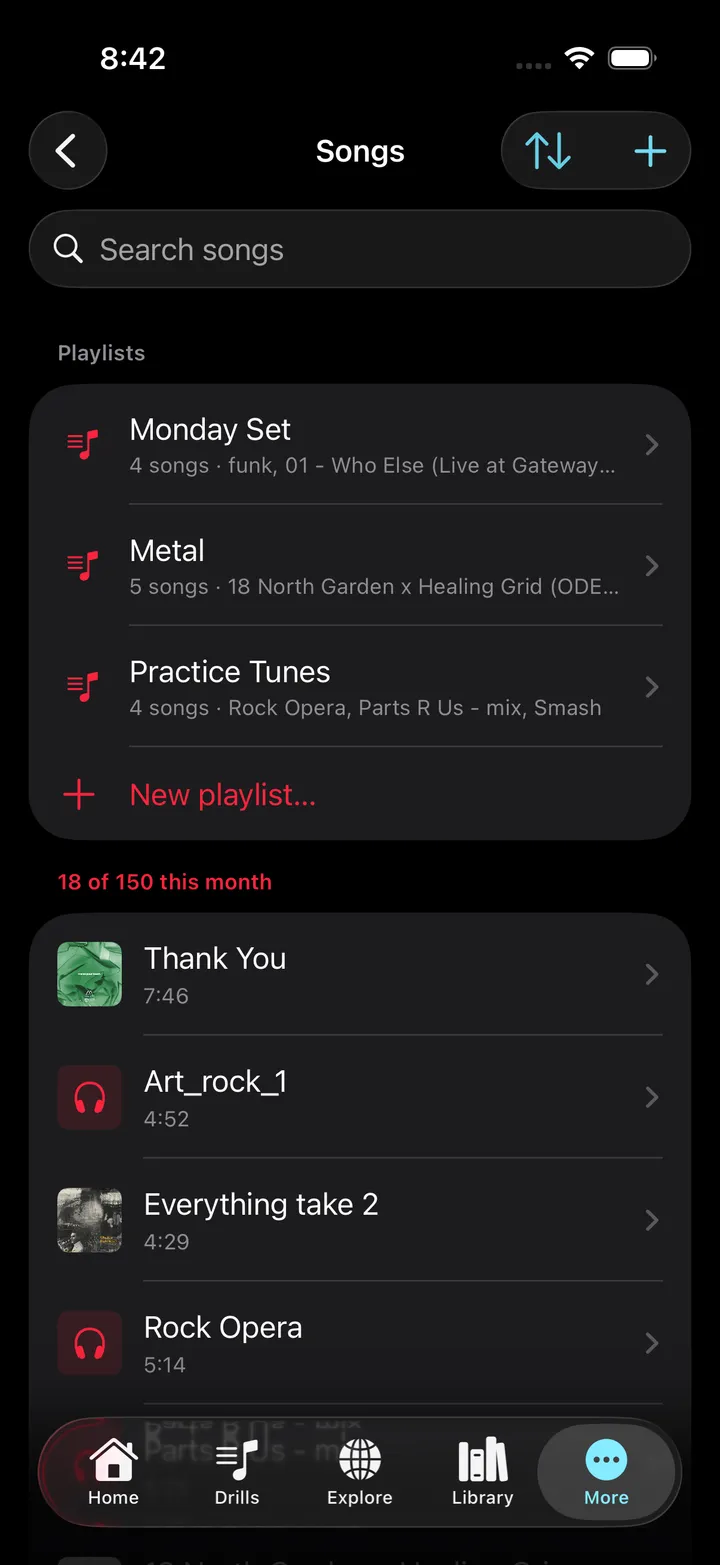
- Three songs a month are free. All Access includes 150 song & sheet-music uploads a month (beta), and the separated stems stay for the life of the upload.
How we handle infringement notices is in our Copyright Policy.
Common questions
How many drumless tracks are there, and in what styles?
Nearly 200 across sixteen genres: rock, funk, jazz, gospel, Latin, blues, R&B, hip-hop, metal, electronic, punk, Afrobeat, pop, reggae, country and fusion. Tempos run from a 61 BPM jazz ballad to a fast swing past 200. The styles the practice paths lean on hardest — rock, funk, gospel, jazz — have two or three takes each.
Are the tempos exact?
Each track’s tempo is measured from its beat grid, not taken from a label, and the grid is checked by hand before a track is published. The click follows that grid bar by bar, so the tempo you read is the tempo you play to.
Are there tracks in 3/4, 6/8 or 5/4?
No — every built-in track is in 4/4. For a waltz, a 6/8 ballad or anything in five or seven, upload a song and DrumShed lays the grid over it; you set the beats per bar in the player.
Do I need my own songs?
No. Songs › Built-in has nearly 200 royalty-free backing tracks spanning sixteen genres — rock, funk, jazz, gospel, Latin, metal and more — each with the drums already separated and a click on its grid. Filter by genre, pick a tempo, play. Uploading is for when it has to be a particular song.
Does it change the pitch when I slow a song down?
No. Speed runs from half speed to full at the same pitch, so a song at 0.6× still sits in its key — you are hearing the band slower, not lower.
How does the click know where the beats are?
When you upload, DrumShed finds the tempo and the downbeats of the take and lays a grid over it bar by bar. The click follows that grid — including tempo drift in a live recording — and you can nudge it earlier or later until it sits right to your ear.
Can I put a song inside a practice session?
Yes. Add a whole song or a bar range — say bars 9 to 16 — as a session item next to your drills, loop it, and it counts toward your practice time and streak like any drill.
Is it free?
Three songs a month are included on every account. All Access includes 150 song & sheet-music uploads a month (beta). The separation runs on our servers, which is why it is metered.
Every drummer needs
a home base.
Sixteen genres, drums already out. Included with All Access.