How to read drum notation
— see it and hear it.
A visual guide to reading drum sheet music. Every example on this page is real notation rendered by DrumShed's engine — press play and watch the staff come alive as you hear it.
Before you start: there's no single "official" drum notation
Drum music has been written a few different ways over the years — publishers occasionally disagree about where a tom sits or how an open hi-hat is marked. What follows is the commonly accepted modern convention you'll meet in most method books, lesson charts, and transcriptions — and it's exactly how DrumShed notates every pattern, so what you learn here reads one-to-one in the app.
The staff (or stave): five lines, one drum kit
Drum music is written on the same five-line staff as any other instrument — but each line and space stands for a different drum or cymbal instead of a pitch. The two stacked numbers at the start are the time signature (4/4 here: four beats per bar), and the symbol before them is the percussion clef. You read left to right, one beat at a time. Here's the first groove everyone learns: hi-hat on every eighth note up top, kick on beats 1 & 3 at the bottom, snare on the backbeats 2 & 4 in the middle.
Where each drum lives on the staff
The rule of thumb: higher on the staff = higher in the kit. Cymbals sit on or above the top line with their stems pointing up. Drums fill the middle with stems pointing down. The feet — kick and hi-hat pedal — hang at the bottom. This example walks the kit top to bottom: crash, hi-hat, ride, ride bell, then snare and the three toms, with the kick and a hi-hat foot chick underneath.
The notehead shape doubles as an instrument label: an oval is a drum, an × is a cymbal or hi-hat (or a stick click), and a diamond (◇) is a bell-type sound — the ride bell or a cowbell.
Hi-hat marks: open ○, closed +, and the foot
The hi-hat is two cymbals you open and close with a pedal, so it carries extra marks. A plain × is a closed (tight) hi-hat. A small circle (○) above the × means open — let it ring and wash. When the hats shut again, the first hi-hat note after the open carries a small + above it: press the pedal closed as you strike it, and the wash stops. An × below the staff is the hi-hat played by the foot alone — the pedal "chick," no stick — and because the foot note itself shows the close, it never needs a +. Listen for the open wash cutting off on the + note:
Cymbal marks: the choke and the crashed ride
Cymbals carry two marks of their own, both from the Percussive Arts Society's standardized drumset notation. An apostrophe just past the upper right of a crash, china or splash is a choke: strike the cymbal and grab it in the same motion so it stops dead instead of ringing — the sharp cut that ends a phrase. Above an accented × on the ride line, a small open arc with a stroke rising off it is the edge mark: the ride is being crashed, struck on its edge hard enough to wash like a crash. Bar 1 below rings a crash on beat 1 and chokes one on beat 3; bar 2 rides the crash all the way through.
Both are real voices in DrumShed, not just marks on the page: each cymbal has its own choke, so a choked china cuts the china and leaves a ringing crash alone, and the ride's articulation cycles bow → bell → crash the same way the snare cycles head → side stick → rim click.
Accents and ghost notes
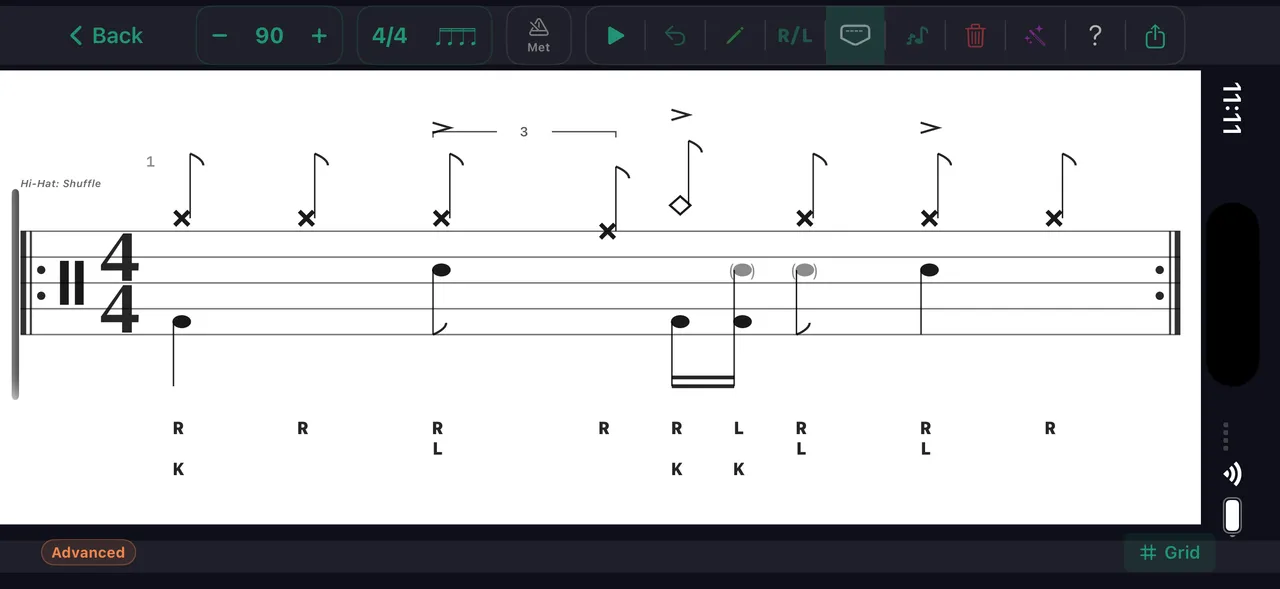
Dynamics are marked right on the note. A small > wedge above a note is an accent — hit it harder; it's the loudest note in the phrase. A notehead wrapped in parentheses is a ghost note — barely there, felt more than heard, the quiet filler that makes funk and groove playing breathe. This bar plays a normal snare, then an accented one, then a ghost:
Sticking letters and flams
The letters under the staff tell you which limb plays each note: R = right hand, L = left hand, B = both, K = kick, LF / RF for the feet. A lowercase letter (r / l) means that hand plays a ghost note. The small grace note tucked in front of a main note (joined by a slur) is a flam — two hits so close together they read as one fat note. Beat 3 below carries a flam:
Drags: two grace notes instead of one
Two small notes beamed together in front of the main hit make a drag — some people call it a ruff. Both grace notes are played by the same hand as a quick double, then the other hand lands the main note: "da-da-DUM". Count the small noteheads to tell them apart: one is a flam, two beamed together is a drag. A drag takes a bit more control than a flam to place cleanly, so a pattern using them counts as harder a little sooner as the tempo climbs.
Diddles: the slash through the stem
A short diagonal line across a note's stem means "play this note twice as fast, same hand" — a diddle. Below, the 3rd and 7th eighths are diddled, so instead of one eighth you play two sixteenths with the right hand. One slash always means twice, whether the note is an eighth or a sixteenth. The sticking letter stays single (one R, not RR) — the slash already says the hand plays twice. Aim for two even strokes: a second stroke quieter than the first is the most common double-stroke fault.
Note values: beams tell you the speed
How a beat is divided shows up in the beams — the thick bars joining note stems. More beams = faster notes. Odd groupings (triplets, quintuplets, sextuplets) get a small number over the beam. Here's a full bar of triplets — three even notes per beat, counted "1-trip-let":
In DrumShed you can print the count above every note — "1 e & a" for sixteenths, "1 trip let" for triplets — in the editor, during live playback, and on exports, with a spoken count-in before the pattern starts.
Quarter-note triplets: one bracket across two beats
Every tuplet above fits inside a single beat. A quarter-note triplet does not: it is three evenly spaced notes stretched across two beats, written as three quarter noteheads under one bracket marked 3. The bracket is how you tell it apart from a beat of ordinary triplets — the number sits over two beats' worth of staff instead of one. The trick to playing one is to count the two beats as ordinary eighth-note triplets and hit every other syllable — six counts, three notes. Below, the groove keeps time on beats 1 and 2, then three snares spread across beats 3 and 4: count "3 trip let 4 trip let" and play "3", "let" and "trip". It's the over-the-bar fill that turns a section around.
The same idea scales: any tuplet written over more than one beat gets a bracket over exactly the beats it covers, and the number tells you how many notes fill them.
Rests: the silences you still count
A bar has to account for every one of its beats whether you play them or not, so silence gets written down too. Every note length has a matching rest worth exactly the same amount of time. Here the snare plays 2 and 4 — beats 1 and 3 are quarter rests, and you keep counting straight through them:
A gap longer than one slot is written with the fewest rests that state its length exactly — three silent sixteenths become an eighth rest plus a sixteenth rest rather than three sixteenth rests. Triplets and other tuplets are the exception: they don't halve into standard rest values, so each silent slot gets its own rest instead.
Other symbols you'll meet
Repeat signs
Thick barlines with dots — play the section again. Every looping pattern on this page starts with one.
Slash notation
Repeat the previous beat or bar. Charts use it to say "keep doing that" without rewriting the bar.
Drum roll (tremolo)
Slashes through a stem mean a roll — rapid repeated strokes. The number of slashes tells you the speed: one slash = eighths, two = sixteenths, three = thirty-seconds. A z through the stem is a buzz (press) roll, and a rudimental chart may name the roll instead — "5" over a note is a five-stroke roll.
Fermata
Hold the note longer than written — the band watches for the cue to move on. Common at big endings.
Repeat signs: the percent-looking symbol
Charts don't write the same bar out over and over. A thick diagonal slash with a dot either side of it — it looks like a % — means "play the previous bar again." Two of them in a row means play that bar twice more, not "repeat the previous two bars"; repeating a two-bar phrase uses a wider sign that straddles the barline with a small 2 above it. Full breakdown, including how these differ from the repeat barlines at the edge of a section, in the guide to drum repeat signs.
The same groove four times: bar 1 written out, bars 2–4 as repeat signs — how a real chart would print it.
Drum notation FAQ
Is there one standard way to write drum notation?
No — unlike pitched instruments, drum notation has no single universally enforced standard. Different books and publishers place a few voices differently. Most modern charts follow the same widely accepted conventions, though: kick in the bottom space, snare in the third space, hi-hat and cymbals up top with × noteheads. That common layout is what this guide teaches, and it is exactly how DrumShed notates every pattern.
What do the × noteheads mean in drum music?
An × notehead is a cymbal or hi-hat — struck metal rather than a drumhead. Ovals are drums (kick, snare, toms), and diamonds are bell-type sounds like the ride bell or a cowbell. An × in the snare’s space is a side-stick (cross-stick) rim click.
What does the small circle above a hi-hat note mean?
A small ○ above a hi-hat note means play it open — let the cymbals ring. When the hats close again, the first hi-hat note after the open carries a small + above it: press the pedal shut as you strike that note. If the foot closes the hats instead, the foot-pedal note below the staff shows the close and no + is needed.
What do the apostrophe and the edge mark on cymbal notes mean?
These follow the Percussive Arts Society's standardized drumset notation. An apostrophe just past the upper right of a crash, china or splash note is a choke: strike the cymbal and grab it at once, so it dies instead of ringing — the sharp cut that ends a phrase. A small open arc on a line, with a stroke rising off it, above an accented × on the ride line is the edge mark: the ride is being crashed, hit on its edge hard enough that it washes like a crash. DrumShed plays both exactly as written, and a choke on a cymbal that is already ringing cuts it off.
What is a quarter-note triplet and how is it written?
Three evenly spaced notes across two beats instead of one — written as three quarter noteheads under a single bracket marked 3, spanning both beats. That two-beat bracket is what distinguishes it from a beat of ordinary eighth-note triplets, which sits over one beat. To play it, count the two beats as eighth-note triplets ("1 trip let 2 trip let") and hit every other syllable. DrumShed writes it as a bracket in the editor and on the staff, exports it as a 3:2 tuplet in MusicXML, and reads one back on import.
What do the letters R, L, and K under the notes mean?
They are sticking labels: R = right hand, L = left hand, B = both hands, K = kick, and LF / RF for the left and right foot. A lowercase letter (r / l) marks a ghost note — the same hand, played very soft.
What is the difference between drum tabs and drum notation?
Drum tabs are a plain-text shorthand (rows of dashes and x’s) that show placement but very little rhythm. Standard drum notation shows both — where each hit lands and exactly how long it lasts — which is why teachers, session charts, and method books all use notation.
How do you write drum notation?
By hand you would draw the five-line staff, place each voice on its own line or space (kick in the bottom space, snare in the third space, cymbals up top with × noteheads), then beam the notes to show the rhythm. In practice most drummers no longer engrave by hand: in DrumShed you tap the pattern into the grid and it renders as real notation instantly, then exports as a sheet-music PDF you can print or hand to a bandmate. Writing it is where the percussion symbols finally stick — you learn them by placing them.
Do I need to read drum notation to play drums?
No — plenty of great drummers play by ear. But reading unlocks method books, lesson charts, and audition material, and it is much faster to learn than pitched-instrument notation: there are no key signatures, just placement and rhythm. Watching notation play back with sound is the quickest way to internalize it.
Keep learning inside DrumShed
This whole guide ships inside the app as the Reading Notation help screen — every example rendered live by the same notation engine, one tap away from any staff you see. Slow any pattern down, loop it, toggle counting syllables, and watch the playhead connect what you see to what you hear.
Every drummer needs
a home base.
Read it, hear it, play it.